
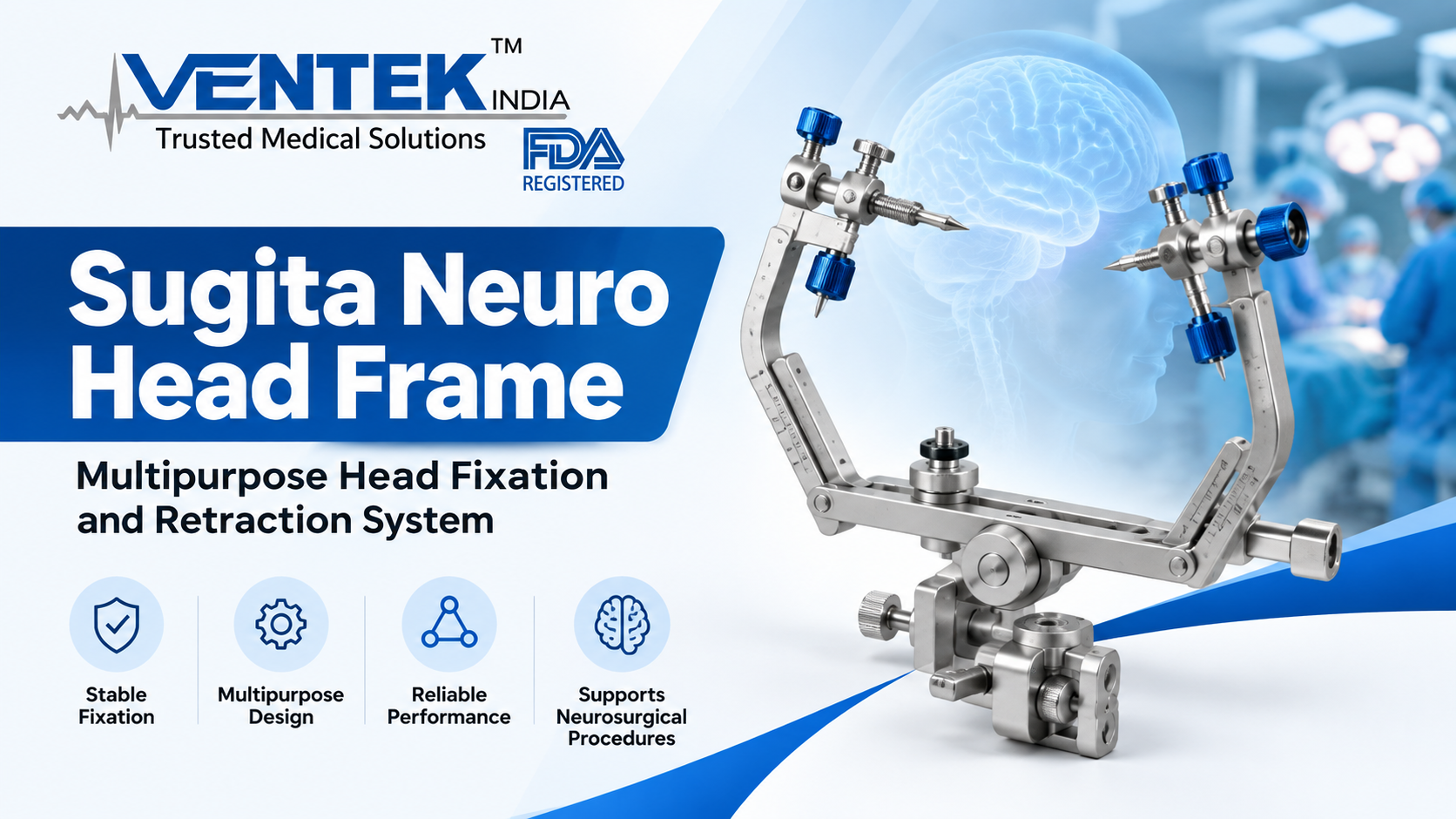
Sugita Neuro Head Frame: Multipurpose Head Fixation and Retraction System
The Sugita neuro head frame is a multipurpose cranial fixation system that holds the patient’s head rigidly on the operating table and, at the same time, works as a mounting platform for self-retaining retractors, scalp hooks and microsurgical accessories. Where a three-pin clamp only fixes the head, a Sugita frame rings the surgical field and gives the surgeon somewhere to anchor everything else.
That single difference is why neuro theatres running long microsurgical lists specify it. In an aneurysm clipping or a deep skull base tumour resection, retraction has to be held steady for hours. With a Sugita frame, the retractors hold themselves, and the assistant who would otherwise be standing there holding a spatula is free to actually assist.
Ventek India manufactures operating theatre equipment from its CDSCO-registered facility at Bawana Industrial Area, New Delhi. With 18+ years in surgical equipment, 30,000+ installations across 27 countries, ISO 13485 certification, CE and USFDA recognition and GeM-approved OEM status, Ventek supplies neuro head frames and attachments matched to the exact OT table model in use.
What Is a Sugita Neuro Head Frame?
A Sugita neuro head frame is a neurosurgical head fixation device that secures the skull using multiple pin positions distributed around a semi-circular basal frame, and then serves as a rigid platform for retractors and surgical accessories. It supports supine, prone, lateral and sitting positions, and is used mainly in extended microneurosurgical procedures.
The design originates from the work of Professor Kenichiro Sugita in Japan, and the name has stuck to the whole class of multipurpose frames built on that pattern. In the Indian market it is written both ways, Sugita and Sujita, and both refer to the same equipment. If you have been quoted a “Sujita neuro attachment”, this is the product being described.
The frame is also known as a Sugita head clamp, Sugita multipurpose head frame, multipurpose neuro head frame, or neuro head frame with retractor system. Different names, one category of device.
Features of the Sugita Neuro Head Frame
Everything in the design points at one goal: hold the head absolutely still, then get out of the surgeon’s way while giving them somewhere to mount what they need.
- Multi-point pin fixation distributed around the frame, which spreads load across more contact points than a three-pin clamp
- Semi-circular basal frame and sub-frame that encircle the surgical field and act as the retraction platform
- Self-retaining retractor arms and brain spatulas mount directly on the frame at any point and angle
- Spring scalp hooks anchor on the frame for flap retraction without separate stands or towel clips
- Retractor slide adjustors that can be attached, repositioned and removed mid-procedure
- Hand rests and cotton plate adjustors that give the surgeon stable support during microsurgery
- Supports supine, prone, lateral and sitting patient positions
- Intraoperative frame rotation, so the approach angle can be changed without re-pinning the patient
- Corrosion-resistant construction in stainless steel and aluminium alloy, autoclave compatible
- Radiolucent variants available where intraoperative angiography is part of the workflow
What Is Included in the System
A Sugita frame is a system rather than a single item, and exactly what ships depends on the configuration ordered. A working neuro configuration typically covers the following.
| Component | Qty | Function |
| Basal frame (head ring) | 1 | Primary skull fixation and retraction platform |
| Sub-frame connector | 1 | Links the frame to the base unit, reduces screw protrusion |
| Base unit | 1 | Mounts the system to the operating table |
| Head pins (standard) | Set | Cranial fixation at multiple points |
| Head pins (long) | Set | For deeper or angled fixation positions |
| Spring scalp hook retractors | Set | Flap retraction anchored to the frame |
| Spring hook adjustors | Set | Multi-notch tensioning for the scalp hooks |
| Retractor slide adjustor | Set | Mounts self-retaining retractors at any point or angle |
| Hand rest | 1 or more | Surgeon support during microsurgery |
| Cotton plate and adjustor | 1 | Instrument and patty placement near the field |
| Horseshoe headrest | Optional | Pin-free support where pinning is not indicated |
| Carry case | 1 | Storage and transport |
Confirm the exact bill of materials against the quotation. Configurations are built around the case mix, and a frame ordered for a general list does not need the same accessory count as one ordered for a dedicated aneurysm service.
Component-Wise Specifications
Basal Frame and Sub-Frame
The frame is the whole point of the system. Its geometry is what lets three semi-circular components share a common centre in the middle of the surgical field, which is what keeps accessory mounting predictable no matter where the surgeon is working from.
| Parameter | Specification |
| Construction | Stainless steel and aluminium alloy, precision machined |
| Frame design | Semi-circular basal frame with sub-frame connector |
| Pin positions | Multiple distributed positions around the frame |
| Accessory mounting | Full circumference, at any point and angle |
| Rotation | Intraoperative rotation without re-pinning |
| Frame diameter range | Confirm from datasheet |
| Weight | Confirm from datasheet |
Head Pins
Pin sets are supplied in standard and long versions. The long pins matter more than they sound, because on an irregular skull contour a standard pin can end up seated at a poor angle, and a poorly seated pin is the one that slips.
Pins are consumables. They are not sharpened and reused. A fatigued or reconditioned pin can fail under sustained load, and single-use pins have become the preferred route in most infection-control protocols.
| Parameter | Specification |
| Pin types | Standard and long |
| Material | Stainless steel, autoclavable variants available |
| Patient group | Adult and paediatric sets, supplied separately |
| Handling | Treated as consumables, replaced not reconditioned |
| Pin count per frame | Confirm from datasheet |
Retractor and Accessory System
This is what you are paying the difference for. On a three-pin clamp, every retractor needs its own independent mounting. On a Sugita frame, the retractor slide adjustor clamps straight onto the ring and can be moved or removed at any point during the procedure.
Spring scalp hooks anchor to the frame through a multi-notch adjustor, which gives graded tension rather than the all-or-nothing pull of a rubber band and hook. Hand rests and the cotton plate mount on the same ring.
| Parameter | Specification |
| Retractor mounting | Slide adjustor, attachable and removable at any point or angle |
| Scalp retraction | Spring hooks with multi-notch tension adjustor |
| Surgeon support | Standard and adjustable hand rests |
| Instrument placement | Cotton plate with adjustable mounting |
| Compatibility | Accessory range as listed in the system catalogue |
Base Unit
The base unit decides whether the system fits your table, so read this section before the purchase order goes out rather than after.
| Parameter | Specification |
| Mounting | Table rails or head-end receptacle, depending on table design |
| Adjustment | Flexible base unit with multi-axis positioning |
| Locking | Single-action lock with tension adjustment |
| Adaptive width | Confirm from datasheet |
| Table compatibility | Matched to the OT table model at enquiry stage |
Technical Specification Summary
| Parameter | Specification |
| Product type | Sugita type multipurpose neuro head frame |
| Also known as | Sujita neuro attachment, Sugita head clamp, multipurpose head frame |
| Application | Microneurosurgery, cranial and skull base surgery |
| Patient group | Adult and paediatric |
| Fixation | Multi-point skull pin fixation around a basal frame |
| Integrated retraction | Yes, retractors and scalp hooks mount on the frame |
| Positions supported | Supine, prone, lateral, sitting |
| Material | Stainless steel and aluminium alloy |
| Radiolucent option | Available for intraoperative angiography workflows |
| Sterilisation | Autoclave compatible, per the IFU supplied |
| Packing | Complete system in a carry case |
| Country of manufacture | India |
Figures above describe the standard system. Confirm against the datasheet for the exact variant quoted, as dimensions and accessory counts differ between configurations.
Procedures Where a Sugita Neuro Head Frame Is Used
A Sugita frame is specified where the case is long, the corridor is deep, and retraction has to be held without drift.
In cerebrovascular work that means aneurysm clipping and AVM resection, where the microscope view has to stay absolutely stable through a delicate dissection. In tumour work it covers skull base approaches, posterior fossa and pineal region surgery, and deep-seated glioma resection where a self-retaining retractor is holding a corridor open for hours at a stretch.
It is also used in transsphenoidal and endoscopic approaches, in functional and stereotactic procedures, and in complex craniovertebral junction surgery where both rigid fixation and accessory mounting are needed at the same time.
For a general neurosurgical and cervical spine list, where cases are shorter and retraction is straightforward, a Mayfield neuro attachment is usually the more sensible specification. The comparison further down sets out where the line falls.
Patient Positions Supported
| Position | Typical use |
| Supine | Pterional, frontal and temporal craniotomy; anterior circulation aneurysms |
| Prone | Posterior fossa, occipital and posterior cervical approaches |
| Lateral | Retrosigmoid and lateral skull base approaches, park-bench positioning |
| Sitting | Posterior fossa and pineal region surgery where gravity drainage is wanted |
Because the frame rotates intraoperatively, the approach angle can be adjusted without releasing and re-pinning the patient. On a long case that is a meaningful safety advantage, not just a convenience.
Sugita Neuro Head Frame vs Mayfield Neuro Attachment
Hospitals specifying a neuro theatre almost always compare these two. They are not interchangeable, and choosing on price alone is how theatres end up buying the wrong one.
| Parameter | Sugita Neuro Head Frame | Mayfield Neuro Attachment |
| Fixation points | Multiple positions around the frame | Three-pin |
| Primary role | Fixation plus integrated retraction platform | Rigid head fixation only |
| Retractor system | Built into the basal frame and sub-frame | Separate, mounted independently |
| Setup time | Longer, more components to assemble | Faster, fewer components |
| Footprint | Larger, rings the surgical field | Compact around the head |
| Accessory mounting | Full circumference of the frame | Limited |
| Best suited to | Extended microneurosurgery, aneurysm, AVM, tumour work | General cranial, cervical spine, navigation cases |
| Cost position | Higher | Lower |
The practical rule: if the theatre runs a general neuro list, the Mayfield attachment covers it and sets up faster. If it runs high-volume microneurosurgery where an assistant would otherwise be tied up holding retraction for hours, the Sugita frame earns its cost back in theatre efficiency alone.
Many neuro theatres end up owning both, and use them by case type rather than by preference.
OT Table Compatibility: Check This Before You Order
The most common procurement failure with any neuro head frame is a system that arrives and will not mount. It is entirely avoidable.
Confirm three things in writing before the purchase order goes out. First, does your operating table have head-end receptacle holes, and at what centre distance. If it does not, you need a rail-mounted base rather than a direct-mount base unit. Second, what is the side rail cross-section in millimetres, because European DIN rails run roughly 25 mm x 10 mm while American rails are closer to 32 mm x 8 mm, and a clamp cut for one will not seat properly on the other. Third, is the table head section removable, since most cranial work requires it off.
There is a fourth consideration specific to the Sugita frame. Because it rings the surgical field and carries retractors, it has a larger working envelope than a three-pin clamp. Check the clearance between the frame, the table column and the surgical light head before specifying, particularly in older theatres with limited head-end space.
Ventek India manufactures surgical OT tables across the Amaze, Electra and Delite series, including electric, electro-hydraulic and C-arm compatible models. When the table and the head frame are specified together, compatibility is confirmed before despatch instead of discovered at installation.
Pin Fixation and Patient Safety
Multi-point fixation distributes load across more contact points than a three-pin clamp, which is one of the arguments in its favour. It does not make the forces involved trivial.
Too little fixation force and the head slips mid-case, which at best costs a navigation re-registration and at worst costs a great deal more. Too much and the risks are skull fracture, dural tear and epidural haematoma. Published neurosurgical guidance generally keeps total vertical force under roughly 350 N, about 80 lb, with paediatric fixation reduced substantially further.
Children under roughly two years of age are generally not pinned at all. A horseshoe headrest is used instead, and any neuro theatre treating paediatric cases should have one on the shelf regardless of which frame it owns.
When evaluating any head fixation system, look closely at the tightening mechanism. A calibrated screw with a visible force setting tells you the manufacturer thought about this. A plain thumbscrew, where “tight” means whatever the last technician decided, does not.
Sterilisation, Cleaning and Maintenance
The frame, sub-frame, base unit and accessory adjustors are reprocessed as instruments and are autoclave compatible. Follow the cycle parameters in the IFU supplied with the unit. Aluminium components tolerate steam but not indefinite repeat cycling at the highest settings, and repeated harsh chemistry will dull the anodising.
A Sugita system has more joints than a three-pin clamp, and joints are what fail first. Check the retractor slide adjustors and spring hook adjustors for wear and creep every six months, and keep the spares list on file from the day the system is commissioned.
Ask any supplier about spares availability before you buy. For a system with this many moving parts, the answer tells you more than the brochure does.
Why Choose Ventek India for Your Neuro Head Frame
There is no shortage of neuro attachments in the Indian market and the photographs all look much the same. What separates suppliers is regulatory standing, installed base, and what happens after the invoice is paid.
Ventek India has manufactured operating theatre equipment for over 18 years from its Bawana, New Delhi facility, with more than 30,000 installations across 27 countries and a distributor network of 1,150+ partners. Manufacturing is CDSCO registered and ISO 13485 certified, with CE and USFDA recognition and GeM-approved OEM status for government procurement.
Manufacturing happens in-house rather than by assembling bought-in components. That matters more than it sounds, because in-house manufacturing is what makes table-specific and rail-specific matching practical instead of theoretical, and it is why compatibility gets confirmed on the quotation rather than on the loading dock.
Because Ventek also manufactures shadowless OT lights and OT pendants, a single specification review can confirm that the light’s working field, the table’s articulation and the head frame’s mounting envelope do not conflict. That check almost never happens when three vendors supply three items, and on a neuro theatre with a frame this size it is exactly the check that needs doing.
The full manufacturing and certification profile is on the Ventek Care company page, and Ventek’s wider range is set out in our guide to OT equipment manufacturing in India. CDSCO registration status can be verified independently on the CDSCO official portal.
Frequently Asked Questions
What is a Sugita neuro head frame used for?
It is used to rigidly fix the patient’s head to the operating table during neurosurgery while also serving as a mounting platform for self-retaining retractors and accessories. It is specified mainly for extended microneurosurgical work such as aneurysm clipping, AVM resection, skull base approaches and deep tumour surgery.
What is the difference between a Sugita and a Mayfield neuro attachment?
A Mayfield attachment provides three-point rigid head fixation and nothing else. A Sugita frame uses multiple pin positions around a basal frame and also acts as a platform for retractors and accessories. Mayfield is faster to set up and lower in cost. Sugita suits long microsurgical cases where integrated retraction frees an assistant.
Is a Sugita head frame the same as a Sujita neuro attachment?
Yes. Both spellings refer to the same class of multipurpose neuro head frame. Sugita is the correct spelling, after Professor Kenichiro Sugita, but Sujita is widely used in Indian tender and quotation documents.
Can a Sugita frame be used for paediatric patients?
Yes, for older children, using a paediatric pin set and substantially reduced fixation force. Infants and very young children are generally a contraindication for pin fixation because the skull is too thin, and a horseshoe headrest is used instead.
Which patient positions does it support?
Supine, prone, lateral and sitting. The frame can also be rotated during the procedure, so the approach angle can be changed without releasing and re-pinning the patient.
Will a Sugita neuro head frame fit my existing OT table?
In most cases yes, but it must be confirmed. Check whether the table has head-end receptacle holes and at what centre distance, and check the side rail cross-section in millimetres. Also check head-end clearance, because the frame has a larger working envelope than a three-pin clamp. Share your table model at enquiry stage and compatibility is confirmed before despatch.
Are radiolucent versions available?
Radiolucent variants of the multipurpose frame exist and are used where intraoperative angiography is part of the cerebrovascular workflow. Specify this requirement at enquiry stage, as it affects both the frame and the accessory selection.
How is a Sugita neuro head frame sterilised?
The frame, sub-frame, base unit and adjustors are autoclavable and reprocessed as instruments, following the cycle parameters in the IFU. Head pins are treated as consumables and replaced rather than reconditioned.
How much force should be applied to the head pins?
Published neurosurgical guidance generally keeps total vertical force below roughly 350 N, about 80 lb, with paediatric fixation reduced substantially further. Always follow the instructions for use supplied with the specific unit and the surgeon’s assessment of the individual patient.
Who manufactures neuro head frames and attachments in India?
Ventek India manufactures neuro OT table attachments from its CDSCO-registered, ISO 13485 certified facility in Bawana, New Delhi, with CE and USFDA recognition and GeM-approved OEM status. Ventek is also an established OT table manufacturer in India and in Delhi, with 18+ years of manufacturing experience and 30,000+ installations.
Can the head frame be ordered along with the operating table?
Yes, and it is the better route. When the OT table and the head frame are specified together, rail dimensions, head-end clearance and mounting compatibility are all confirmed on one specification review rather than across two vendors.
Request a Quote for a Sugita Neuro Head Frame
The useful conversation starts with your operating table model, rail dimensions and case mix, not with a catalogue. Send those across and Ventek India will confirm compatibility, advise on pin and accessory configuration for the procedures you actually run, and quote for supply and installation across India and for export.
Ventek Care Pvt. Ltd. — Manufacturing Unit 1, M-155, Sector 3, Bawana Industrial Area, New Delhi 110039, India.
Send your enquiry through the Ventek India contact page or on WhatsApp at +91 99990 49518 to request the catalogue or arrange a demonstration.








Comments are currently closed.