
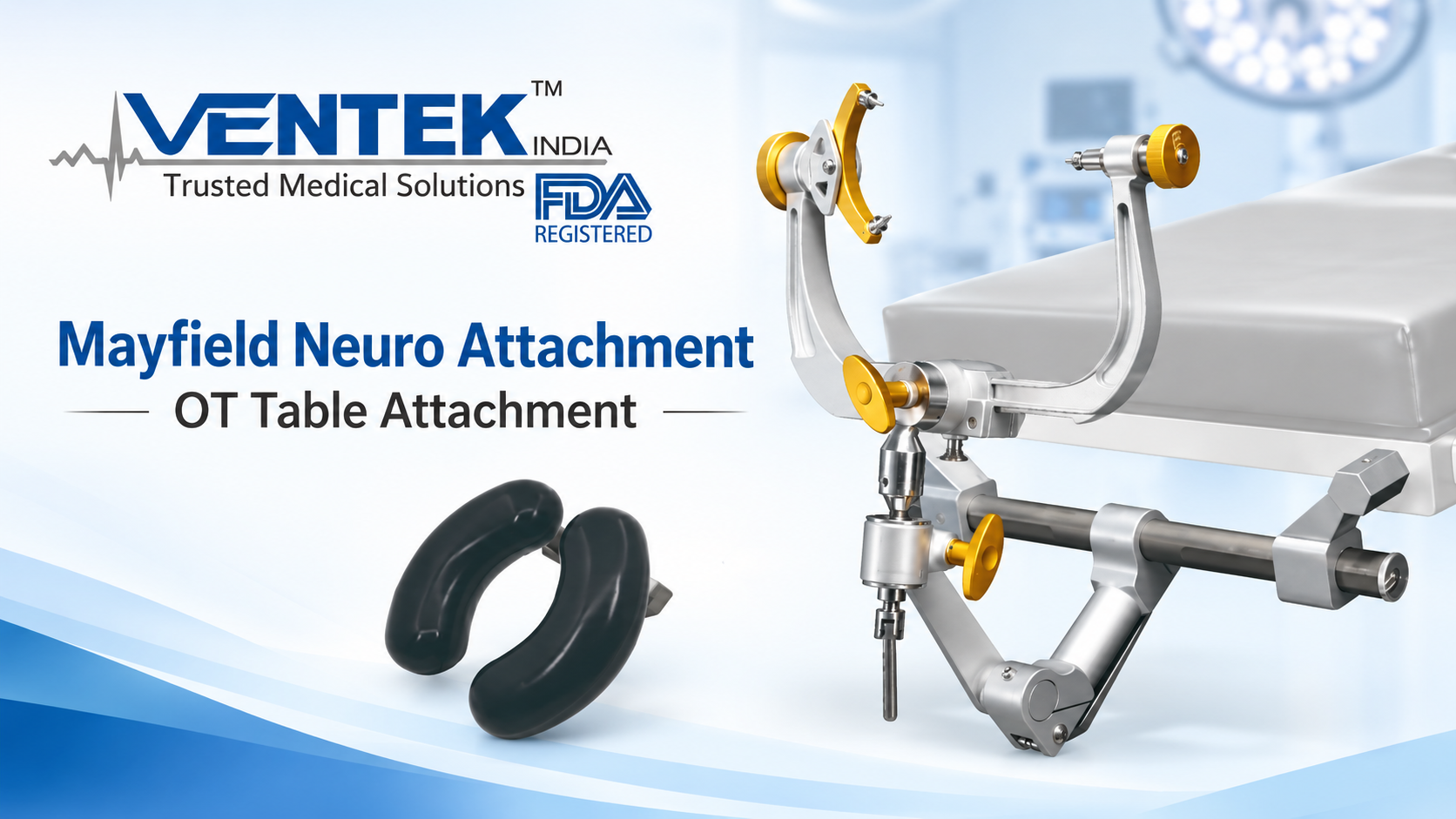
Mayfield Neuro Attachment – OT Table Attachment
Mayfield Type Neuro Attachment for Neurosurgery and Spinal OT Tables
The Mayfield neuro attachment is a three-point cranial fixation system that mounts to a surgical operating table and holds the patient’s head rigidly in place throughout neurosurgical and spinal procedures. Supplied by Ventek India as a complete kit — head clamp, base unit, ball socket adaptor, silica horseshoe headrest and both adult and paediatric skull pins — this neuro OT table attachment supports prone, supine, lateral and sitting positions on a single system.
Ventek India manufactures operating theatre equipment from its CDSCO-registered facility at Bawana Industrial Area, New Delhi. With 18+ years in surgical equipment, 30,000+ installations across 27 countries, ISO 13485 certification, CE and USFDA recognition and GeM-approved OEM status, Ventek supplies neuro attachments matched to the exact OT table model in use.
What is a Mayfield neuro attachment?
A Mayfield neuro attachment is a neurosurgical head fixation device that clamps the skull at three points and locks it to the operating table. Two rocker-arm pins press against one side of the head and a single pin opposes them from the other, producing rigid immobilisation so the surgeon can operate under a microscope or with neuronavigation without any movement of the surgical field.
It is known by several names in the market — Mayfield head clamp, Mayfield skull clamp, Mayfield head attachment, neuro OT table attachment, three point head fixation device. They all describe the same class of equipment. Ventek supplies it as a Mayfield type neuro attachment, meaning it follows the established Mayfield design pattern and is dimensionally compatible with DORO and Mayfield swivel adaptors already in use in most Indian neuro theatres.
Features of the Ventek Mayfield neuro attachment
The design brief for this kit was simple: cover the full neuro and spinal list with one system, keep the weight low enough that a single OT technician can set it up, and make sure it locks without drift over a six-hour case.
- Basic model with a lightweight build, easy for one person to mount and set
- Meets the majority of clinical demands in neurosurgery and spinal surgery
- Suitable for both paediatric and adult patients, with separate pin sets supplied for each
- Produced from standard aluminium alloy and stainless steel for durability and strength
- Stable, high-precision three-point fixation of the head with no lateral play under load
- Easy-fixation ball socket adaptor that gives the surgeon an unobstructed view of the field
- Supports the patient in prone, supine, lateral and sitting positions
- Connect teeth match DORO and Mayfield swivel adaptors, so existing accessories remain usable
- Supplied as a complete kit packed in a single carry box
What is included in the kit
Every Mayfield neuro attachment kit ships complete. Nothing in this list is an optional extra.
| Component | Qty | Function |
| Head Clamp | 1 | Three-point skull fixation |
| Base Unit | 1 | Mounts the system to the OT table |
| Ball Socket Adaptor | 1 | Angle adjustment and locking |
| Silica Headrest (horseshoe) | 1 | Pin-free cranial support |
| Skull Pins — Adult | 3 | Adult cranial fixation |
| Skull Pins — Paediatric | 3 | Reduced-force paediatric fixation |
| Carry box | 1 | Storage and transport |
Component-wise specifications
Head Clamp
Machined from a single block of aluminium alloy on a CNC centre, which is what gives it strength without bulk. Lightweight enough to set single-handed, and the geometry is fixed rather than welded, so it does not lose alignment over time.
| Parameter | Specification |
| Construction | Single-block aluminium alloy, CNC machined, high strength |
| Clamping width | 12 cm to 24 cm (pin tip to pin tip) |
| Clamping depth | Up to 13 cm (single-pin side tip to bottom) |
| Pin configuration | Three-point — two rocker-arm pins opposing one fixed pin |
| Handling | Lightweight design, quick to set and release |
Base Unit
The base unit is the part that decides whether the whole system fits your table, so it is worth reading this row by row before ordering.
| Parameter | Specification |
| Maximum adaptive width | 55 cm (rod to rod) |
| Locking | Easy lock handle for single-action engagement |
| Tension control | Adjusting screw sets the tightening force |
| Compatibility | Connect teeth match DORO and Mayfield swivel adaptors |
| Mounting | Table rails or head-end receptacle, depending on table design |
Ball Socket Adaptor
Stainless steel ball and socket, which stays smooth to position and then holds. High-precision machining on the joint faces is what stops the slow creep that cheaper adaptors develop after a year in service.
| Parameter | Specification |
| Material | Stainless steel ball socket |
| Adjustment | Free positioning through full range, then locked in one action |
| Locking | High-precision machined joint for firm, drift-free locking |
| Durability | Stable under sustained load through long procedures |
Silica Headrest (Horseshoe)
The horseshoe headrest is not an accessory — it is the alternative when pins are not appropriate. Infants and very young children are usually a contraindication for pin fixation because the skull is too thin, and short procedures often do not justify pinning at all.
| Parameter | Specification |
| Shape | Horseshoe, open at the face for airway access |
| Use | Cranial support in prone or supine position |
| Patient group | Infants, young children, and adults where pins are not indicated |
| Adjustment | Adjustable pad base accommodates various head sizes |
| Cleaning | Silica surface, easily cleaned and wiped down |
Skull Pins — Adult and Paediatric
Three adult pins and three paediatric pins ship with every kit. The difference is not just size — paediatric fixation uses substantially lower force, and using an adult pin set on a child is how skull fractures happen. Keep the two sets separately labelled in your CSSD tray.
Replacement pins should be ordered as a consumable line item rather than sourced ad hoc. A pin that has been resharpened or fatigued is a pin that can slip under load, and single-use pins have become the preferred route in most infection-control protocols.
Technical specification summary
| Parameter | Specification |
| Product type | Mayfield type neuro attachment / three-point head fixation device |
| Application | Neurosurgery and spinal surgery |
| Patient group | Paediatric and adult |
| Fixation | Three-point skull pin fixation, or pin-free horseshoe support |
| Positions supported | Prone, supine, lateral, sitting |
| Material | Aluminium alloy and stainless steel |
| Clamping width | 12–24 cm (pin to pin) |
| Clamping depth | Up to 13 cm |
| Base unit width | Adjustable up to 55 cm rod to rod |
| Adaptor compatibility | DORO / Mayfield swivel adaptors |
| Packing | Complete kit in a single box |
| Country of manufacture | India |
Figures above describe the standard model. Confirm against the datasheet for the exact variant quoted, as dimensions differ between models.
Procedures where a Mayfield neuro attachment is used
This is the section most product pages leave out, and it is the one surgeons actually search for. A Mayfield head clamp is indicated wherever the head must stay in a fixed relationship to the table.
In cranial work that covers open craniotomy, posterior fossa approaches, skull base surgery, aneurysm and AVM clipping, tumour resection, and any navigation-guided procedure where registration accuracy depends on the head not moving. In spinal work it covers posterior cervical laminectomy, cervical fusion and craniovertebral junction surgery, where the head and neck alignment set at the start of the case has to hold to the end of it.
It is also used for functional and stereotactic procedures, and in trauma cases where the cervical spine has to be held in a controlled position during cranial decompression.
Patient positions supported
One system, four positions — which is the practical reason the Mayfield design has outlasted almost every alternative.
| Position | Typical use |
| Supine | Frontal, temporal and pterional craniotomy; most anterior approaches |
| Prone | Posterior fossa, occipital and posterior cervical spine procedures |
| Lateral | Retrosigmoid and lateral skull base approaches; park-bench positioning |
| Sitting | Posterior fossa and pineal region surgery where gravity drainage is wanted |
OT table compatibility — check this before you order
The single most common procurement failure with neuro attachments is a kit that arrives and will not mount. It is entirely avoidable.
Confirm three things in writing before the purchase order goes out. First, does your operating table have head-end receptacle holes, and at what centre distance — if it does not, you need a rail-mounted base instead of a direct-mount base unit. Second, what is the side rail cross-section in millimetres, because European DIN rails run roughly 25 mm × 10 mm while American rails are closer to 32 mm × 8 mm and a clamp cut for one will not seat properly on the other. Third, is the table’s head section removable, since most cranial work requires it off.
If you already own DORO or Mayfield swivel adaptors, mention that at enquiry stage. The connect teeth on this base unit are designed to match them, so in many cases only the base unit needs replacing rather than the whole system.
Ventek India also manufactures surgical OT tables across the Amaze, Electra and Laminar series, so when the table and attachment are specified together compatibility is confirmed before despatch instead of discovered at installation.
Pin torque and paediatric safety
Pin fixation works by compressing the skull between three points, and the force involved is not trivial.
Too little and the head slips mid-case, which at best costs you a navigation re-registration. Too much and you risk a skull fracture, a dural tear, or an epidural haematoma. Published neurosurgical guidance generally keeps total vertical force under roughly 350 N — about 80 lb — with adult fixation commonly set well below that and paediatric fixation reduced substantially further.
Children under about two years are generally not pinned at all. That is what the silica horseshoe headrest in the kit is for, and it is the reason a kit without one is an incomplete kit.
When you evaluate any head clamp, look hard at the tightening mechanism. A calibrated screw with a visible force setting tells you the manufacturer thought about this. A plain thumbscrew where “tight” means whatever the last technician decided does not.
Sterilisation, cleaning and maintenance
The head clamp, base unit and ball socket adaptor are reprocessed as instruments and are autoclave compatible. Follow the cycle parameters in the IFU supplied with the unit; aluminium components tolerate steam but not indefinite repeat cycling at the highest settings, and repeated harsh chemistry will dull the anodising.
The silica headrest is a wipe-down item. Skull pins should be treated as consumables and replaced rather than reconditioned.
For maintenance, the joints fail first. Check the ball socket adaptor for creep under load and the lock handle for wear every six months, and keep the spares list on file from day one. Ask any supplier about spares availability before you buy — the answer tells you more about them than the brochure does.
Mayfield neuro attachment vs Sujita neuro attachment
Hospitals specifying a neuro theatre usually end up comparing these two, and they are not interchangeable.
| Parameter | Mayfield Neuro Attachment | Sujita / Sugita Neuro Attachment |
| Fixation points | Three-pin | Commonly four to six pin positions |
| Primary role | Rigid head fixation | Fixation plus integrated retraction platform |
| Retractor system | Separate, mounted independently | Built into the basal frame and sub-frame |
| Setup time | Faster, fewer components | Longer, more components to assemble |
| Footprint | Compact around the head | Larger, rings the surgical field |
| Best suited to | General cranial, cervical spine, navigation cases | Extended microneurosurgery, aneurysm, AVM, tumour work |
| Cost position | Lower | Higher |
The short version: if the theatre runs a general neuro list, the Mayfield attachment covers it. If it runs high-volume microneurosurgery where an assistant is otherwise tied up holding retraction, the Sujita frame earns its cost.
Why choose Ventek India as your Mayfield neuro attachment manufacturer
There is no shortage of neuro attachments in the Indian market and the photographs all look much the same. What separates suppliers is regulatory standing, installed base and what happens after the invoice is paid.
Ventek India has manufactured operating theatre equipment for over 18 years from its Bawana, New Delhi facility, with more than 30,000 installations across 27 countries and a distributor network of 1,150+ partners. Manufacturing is CDSCO registered and ISO 13485 certified, with CE and USFDA recognition and GeM-approved OEM status for government procurement. The company holds design and technology patents on its surgical lighting and manufactures in-house rather than assembling bought-in components.
That last point matters more than it sounds. In-house manufacturing is what makes table-specific and rail-specific matching practical instead of theoretical, and it is why compatibility gets confirmed on the quotation rather than on the loading dock.
Because Ventek also manufactures shadowless OT lights and OT pendants, a single specification review can confirm that the light’s working field, the table’s articulation and the neuro attachment’s mounting envelope do not conflict — a check that almost never happens when three vendors supply three items.
The full manufacturing and certification profile is on the Ventek India company profile page, and the complete range is on the
CDSCO registration status can be verified independently on the CDSCO official portal.
Frequently asked questions
What is a Mayfield neuro attachment used for?
A Mayfield neuro attachment is used to rigidly fix the patient’s head to the operating table during neurosurgical and spinal procedures. It is indicated for craniotomy, posterior fossa and skull base surgery, aneurysm and tumour work, posterior cervical laminectomy and fusion, and any navigation-guided case where head movement would invalidate the registration.
What is included in a Mayfield neuro attachment kit?
A complete kit contains one head clamp, one base unit, one ball socket adaptor, one silica horseshoe headrest, three adult skull pins and three paediatric skull pins, packed in a single carry box. Nothing on that list is an optional extra.
Is the Mayfield neuro attachment suitable for children?
Yes, for older children, using the paediatric skull pin set supplied with the kit and substantially reduced fixation force. Infants and very young children are generally a contraindication for pin fixation because the skull is too thin, and the silica horseshoe headrest is used instead.
What is the clamping width of the head clamp?
The head clamp adjusts from 12 cm to 24 cm pin tip to pin tip, with a clamping depth of up to 13 cm measured from the single-pin side tip to the bottom. This range covers paediatric through adult head sizes.
Will a Mayfield neuro attachment fit my existing OT table?
In most cases yes, but it must be confirmed. Check whether your table has head-end receptacle holes and at what centre distance, and check the side rail cross-section in millimetres — European DIN rails are around 25 mm x 10 mm and American rails around 32 mm x 8 mm. Share your table model at enquiry stage and compatibility is confirmed before despatch.
Is this attachment compatible with DORO swivel adaptors?
Yes. The connect teeth on the base unit are designed to match DORO and Mayfield swivel adaptors, so hospitals that already own compatible adaptors can often replace only the base unit rather than the complete system.
Which patient positions does it support?
Prone, supine, lateral and sitting. A single system therefore covers most of a general neurosurgical and spinal list, which is the main practical reason the Mayfield design has remained standard for decades.
How much force should be applied to the skull pins?
Published neurosurgical guidance generally keeps total vertical force below roughly 350 N, about 80 lb, with adult fixation commonly set well below that and paediatric fixation reduced substantially further. Always follow the instructions for use supplied with the specific unit and the surgeon’s assessment of the individual patient.
How is a Mayfield neuro attachment sterilised?
The head clamp, base unit and ball socket adaptor are autoclavable and reprocessed as instruments, following the cycle parameters in the IFU. The silica headrest is a wipe-down item. Skull pins are treated as consumables and replaced rather than reconditioned.
Who manufactures Mayfield neuro attachments in India?
Ventek India manufactures neuro OT table attachments from its CDSCO-registered, ISO 13485 certified facility in Bawana, New Delhi, with CE and USFDA recognition and GeM-approved OEM status. The company has 18+ years of manufacturing experience, 30,000+ installations and distribution across 27 countries.
What is the difference between a Mayfield and a Sujita neuro attachment?
A Mayfield attachment provides three-point rigid head fixation and nothing else. A Sujita or Sugita neuro attachment uses four to six pin positions and also acts as a mounting platform for self-retaining retractors and accessories. Mayfield is faster to set up and lower in cost; Sujita suits extended microneurosurgery where integrated retraction frees an assistant.
Request a quote for a Mayfield neuro attachment
The useful conversation starts with your operating table model and rail dimensions, not with a catalogue. Send those across and Ventek India will confirm compatibility, advise on pin and headrest configuration for your case mix, and quote for supply and installation across India and for export.
Ventek Care Pvt. Ltd. — Manufacturing Unit 1, M-155, Sector 3, Bawana Industrial Area, New Delhi 110039, India.
Send your enquiry through the Ventek India contact page or on WhatsApp at +91 99990 49518 to request the catalogue or arrange a demonstration.








Comments are currently closed.