
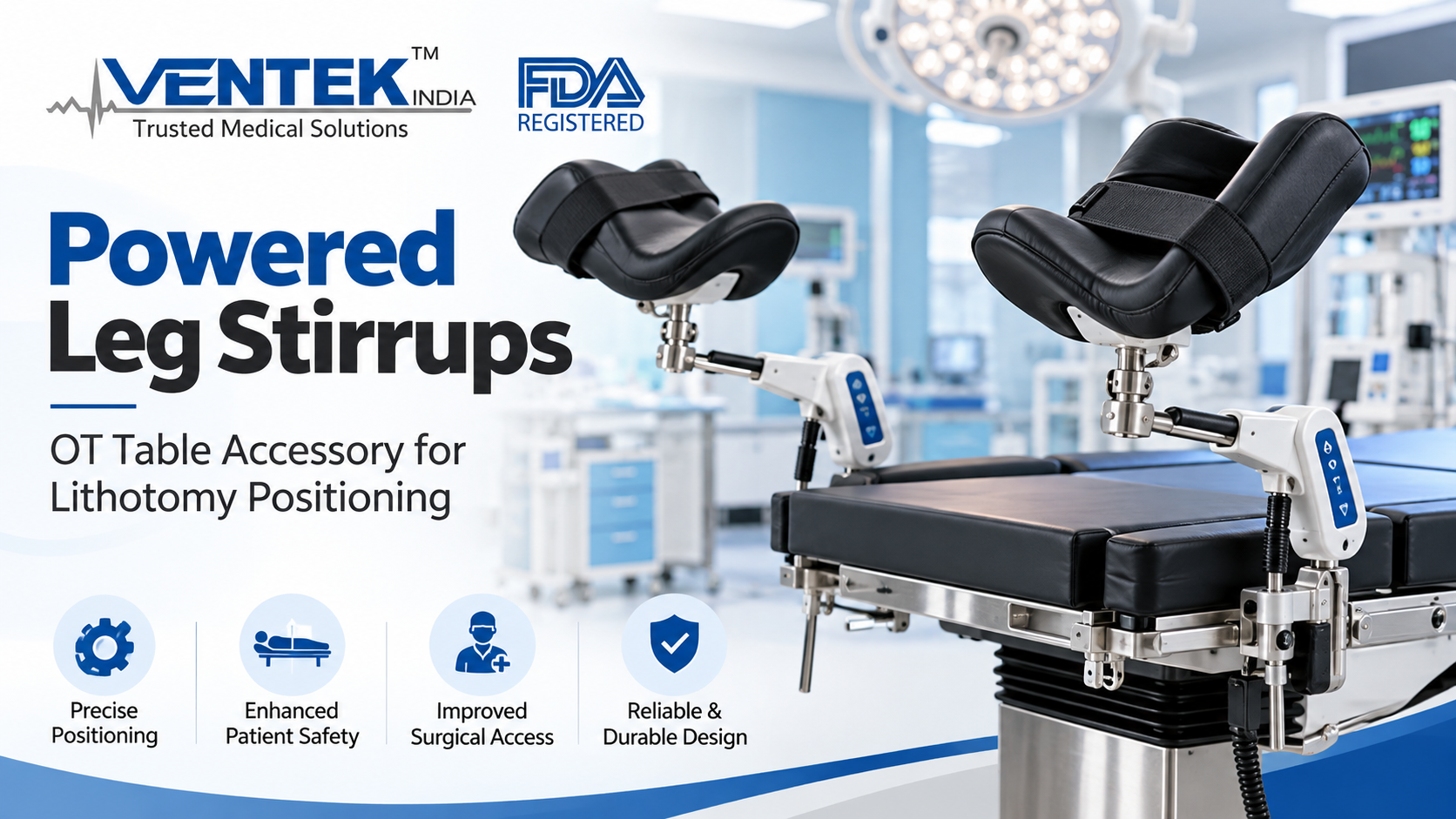
Powered Leg Stirrups – OT Table Accessory for Lithotomy Positioning
Ask any OT nurse what the hardest part of a lithotomy case is, and a lot of them won’t say the surgery. They’ll say lifting the legs. Two staff members, one on each side, holding a sedated patient’s legs up while someone else locks the stirrups in place. It’s slow, it strains backs, and it’s exactly where hip and nerve injuries can start.
Powered leg stirrups take that job off the staff. A built-in lift-assist carries the weight of the leg, so one person can raise, lower and angle it with a single handle. The patient goes into position smoothly, and the team can fine-tune the angle during the case without breaking the sterile field.
Ventek India has been making operating theatre equipment for over 18 years from its CDSCO-registered facility at Bawana Industrial Area, New Delhi. With 30,000+ installations across 27 countries, ISO 13485 certification, CE and USFDA recognition, and GeM-approved OEM status, Ventek supplies leg stirrups and lithotomy accessories matched to the exact OT table they will be used on.
What are powered leg stirrups?
Powered leg stirrups are boot-style leg supports that clamp onto the side rails of an operating table and use a lift mechanism to raise and hold the patient’s legs. The mechanism is usually a gas spring or pneumatic cylinder, and on some designs a small motor. Either way, it carries most of the leg’s weight so the staff don’t have to.
You’ll hear them called by a few names in the market: power lift stirrups, power-assist stirrups, motorised leg stirrups, electric stirrups, or lift-assist boot stirrups. They all mean the same thing — a booted leg holder that moves with help, not by muscle alone.
The older alternatives are candy-cane stirrups (the leg hangs from a strap at the ankle) and knee crutches (the leg rests on a padded knee support). Both still work for short cases. But they put pressure on small areas, need two people to set, and don’t let you change the angle easily once the drapes are on. That’s the gap powered stirrups fill.
How powered leg stirrups work
The idea is simple. A lift unit sits inside the stirrup arm, between the rail clamp and the boot. When the staff member squeezes or twists the release handle, the lift unit takes the load and the arm moves freely. Let go of the handle and it locks wherever you left it.
That single-handle action controls two movements:
- Lithotomy angle – how high the leg is raised, from low lithotomy up to exaggerated lithotomy
- Abduction and adduction – how far the legs open outward or come back in
Because the handle sits at the foot end, it can be operated from under the drape. The surgeon asks for “a little higher” mid-case, and the nurse adjusts it in seconds without anyone touching the sterile field.
Key features to look for
Not every stirrup sold as “powered” works the same way. These are the features that actually matter in day-to-day OT use:
- Lift-assist mechanism that holds the full leg weight, so one person can position the patient
- Single-handle control for both lithotomy angle and abduction/adduction
- Full-length padded boot that supports the calf and heel, not just the ankle
- Secure straps to hold the leg in the boot during table tilts
- Stainless steel or coated steel arm that cleans easily and doesn’t rust
- Rail clamp that fits your table’s side rail profile without wobble
- Latex-free, fluid-resistant pads that can be wiped down between cases
- Size options for adult, bariatric and paediatric patients
Typical specifications – what to compare
Use this table as a checklist when you compare quotations. Exact figures change by model, so always ask for the datasheet of the variant being quoted.
| Parameter | What to check | Typical range in the market |
|---|---|---|
| Patient weight capacity | Must match or stay below the OT table’s rated load | Around 150 kg for adult models; higher for bariatric |
| Lithotomy range | How high and low the leg can go | Roughly +80° to −30° |
| Abduction / adduction | How far legs can open and close | Roughly +25° / −9° |
| Lift mechanism | Gas spring, pneumatic or motor | Gas spring is most common |
| Control | One handle or separate knobs | Single grip-and-twist handle preferred |
| Boot padding | Full-length, removable, latex-free | Washable foam or gel pads |
| Mounting | Side rail clamp | Fits standard 25 mm × 10 mm (European) rails |
| Sizes | Adult, bariatric, junior, paediatric | Adult and bariatric are the core range |
One thing many buyers miss: the stirrups themselves add weight to the table. When you check the table’s maximum patient load, include the accessory weight in your calculation.
Procedures where powered leg stirrups are used
Any case done in the lithotomy position can benefit. The most common ones in Indian hospitals are:
- Gynaecology – hysteroscopy, D&C, vaginal hysterectomy, laparoscopic hysterectomy (LAVH/TLH), pelvic floor repair
- Urology – TURP, TURBT, cystoscopy, ureteroscopy, PCNL in the modified lithotomy position
- Colorectal and general surgery – haemorrhoidectomy, fistula and fissure surgery, low anterior resection, abdomino-perineal resection
- Robotic and laparoscopic pelvic surgery – where the legs often need to be repositioned during the case
The longer and more complex the case, the more powered stirrups pay off. In a three-hour laparoscopic pelvic surgery with steep Trendelenburg, the boot design and secure locking matter far more than in a ten-minute cystoscopy.
Lithotomy positions supported
| Position | How the legs sit | Common use |
|---|---|---|
| Low lithotomy | Hips slightly flexed, legs low | Laparoscopic pelvic and colorectal surgery |
| Standard lithotomy | Hips and knees flexed to about 90° | Gynae, urology, perineal procedures |
| High lithotomy | Legs raised higher and closer to the trunk | Perineal and anal surgery |
| Exaggerated lithotomy | Thighs pushed toward the chest | Deep perineal and some prostate procedures |
Good powered stirrups move through all of these with the same handle, which is why one set can cover most of a hospital’s lithotomy list.
Sizes: adult, bariatric and paediatric
One size does not fit everyone, and a boot that’s too big or too small is a pressure-injury risk.
- Adult stirrups cover the bulk of daily cases
- Bariatric stirrups have a wider boot and a stronger lift unit for heavier patients — worth having at least one set if your hospital does obesity or high-volume gynae work
- Junior and paediatric stirrups use a smaller boot and lighter lift so the leg isn’t over-supported or pushed into the wrong angle
Powered leg stirrups vs manual stirrups
This is the comparison most purchase committees end up making.
| Point | Powered leg stirrups | Candy-cane / knee crutch stirrups |
|---|---|---|
| Staff needed to position | One person | Usually two |
| Lifting effort | Lift unit carries the leg weight | Staff lift the full leg |
| Adjusting during surgery | Yes, from under the drape | Hard once drapes are on |
| Leg support | Full calf and heel in a padded boot | Ankle strap or knee pad only |
| Pressure points | Spread over a larger area | Focused on ankle or back of knee |
| Best for | Long cases, laparoscopic and robotic work, heavy patients | Short, simple procedures |
| Cost | Higher | Lower |
The short answer: if your OT does mostly quick diagnostic cases, manual stirrups may be enough. If it runs long gynae laparoscopy, urology or colorectal lists, powered stirrups save staff effort and reduce positioning risk every single day.
OT table compatibility – check this before you order
The most common buying mistake with stirrups is the same one we see with every table accessory: it arrives and won’t fit the rail.
Check these three things in writing before the purchase order goes out:
- Side rail size – European DIN rails are about 25 mm × 10 mm, while American rails are closer to 32 mm × 8 mm. A clamp made for one won’t sit properly on the other.
- Rail position and length – make sure there’s clear rail space at the right spot on the leg section, so the clamps don’t clash with other accessories.
- Table weight rating – the stirrups add load at the foot end. Your table’s patient weight limit has to cover the patient plus the accessories.
Ventek India also manufactures surgical OT tables across its Amaze, Electra and Laminar series. When the table and stirrups are specified together, the fit is confirmed before despatch — not discovered at installation.
Patient safety in the lithotomy position
Lithotomy is one of the riskier positions in surgery, and the stirrups are a big part of why. The main risks are:
- Nerve injury – especially the common peroneal nerve at the side of the knee, which gets pressed if the leg rests against a hard edge
- Compartment syndrome – in long cases where the legs stay raised for hours
- Hip strain – when both legs are lifted unevenly or too fast
Powered stirrups help with all three. The padded boot spreads pressure, and the lift-assist lets staff raise both legs slowly and together. Even so, good practice still applies: lift both legs at the same time, check that nothing presses on the outer knee, and reassess the legs during long cases. Always follow the instructions for use supplied with the unit.
Cleaning and maintenance
The boot pads should be wiped down after every case with a hospital-grade disinfectant that’s approved for the pad material. Check the pads regularly for cracks or tears — a damaged pad can trap fluid and stops protecting the leg properly.
For the mechanism, the lift unit and the clamp are what wear first. Check every six months that the arm holds its position under load without slowly dropping, and that the clamp grips the rail firmly. Keep a list of spare pads and clamps on file from day one, and ask any supplier about spares availability before you buy.
Why choose Ventek India for powered leg stirrups
Photos of leg stirrups look much the same from one supplier to the next. What really sets them apart is whether they fit your table, how long the mechanism lasts, and who picks up the phone when a clamp needs replacing.
Ventek India has manufactured operating theatre equipment for 18+ years from its Bawana, New Delhi facility. The company has more than 30,000 installations across 27 countries and a network of 1,150+ distributors. Manufacturing is CDSCO registered and ISO 13485 certified, with CE and USFDA recognition and GeM-approved OEM status for government buying.
Because Ventek builds its own tables, rail and clamp matching is handled in-house. And since it also makes shadowless OT lights and OT pendants, one specification review can check that the light, the table and its accessories all work together — something that rarely happens when three vendors supply three items. For a fully connected theatre, see the VentekSafe Smart OT range.
If you’re also setting up a neuro theatre, our guide to the Mayfield neuro attachment covers head fixation for the same tables. You can read more about the company on the Ventek India company profile page, see hospitals we’ve equipped on the projects page, and verify CDSCO registration on the CDSCO official portal.
Frequently asked questions
What are powered leg stirrups used for?
Powered leg stirrups are used to lift and hold a patient’s legs in the lithotomy position during surgery. They’re common in gynaecology, urology and colorectal procedures, and in laparoscopic or robotic pelvic surgery where the leg angle may need changing mid-case.
How are powered stirrups different from normal stirrups?
Normal stirrups need staff to lift the full weight of the leg, usually with two people. Powered stirrups have a lift-assist unit that carries the leg’s weight, so one person can raise, lower and angle it with a single handle.
Can the leg position be changed during surgery?
Yes. The control handle sits at the foot end and can be worked from under the sterile drape. The nurse can change the lithotomy angle or how far the legs are opened without touching the sterile field.
Will powered leg stirrups fit my existing OT table?
In most cases yes, but check it first. Confirm your side rail size in millimetres — European rails are about 25 mm × 10 mm and American rails about 32 mm × 8 mm. Share your table model when you enquire and Ventek will confirm the fit before despatch.
What is the weight capacity of powered stirrups?
It depends on the model. Adult stirrups typically handle standard adult patients, while bariatric models are built for heavier loads. Always check that your OT table’s rated load covers the patient plus the weight of the accessories.
Are powered leg stirrups available for children?
Yes. Junior and paediatric versions use a smaller boot and lighter lift so the leg is supported at the right angle without too much force.
Do powered stirrups reduce the risk of nerve injury?
They help. The full-length padded boot spreads pressure away from the outer knee, where the peroneal nerve runs, and the lift-assist lets both legs be raised slowly and evenly. Good positioning practice and regular checks during long cases are still needed.
How do I clean powered leg stirrups?
Wipe the boot pads after every case with a disinfectant approved for the pad material. The metal arm and clamp can be wiped down too. Follow the cleaning steps in the instructions for use supplied with your unit.
Who manufactures OT table leg stirrups in India?
Ventek India supplies leg stirrups and OT table accessories from its CDSCO-registered, ISO 13485 certified facility in Bawana, New Delhi. The company has 18+ years of experience, 30,000+ installations, and distribution across 27 countries.
Request a quote for powered leg stirrups
The best conversation starts with your OT table model and rail size, not a catalogue. Send those across and the Ventek team will confirm the fit, suggest the right sizes for your case mix, and quote for supply and installation across India and for export.
Ventek Care Pvt. Ltd. — Manufacturing Unit 1, M-155, Sector 3, Bawana Industrial Area, New Delhi 110039, India.
Send your enquiry through the Ventek India contact page or on WhatsApp at +91 99990 49518 to get the catalogue or book a demo.






Comments are currently closed.