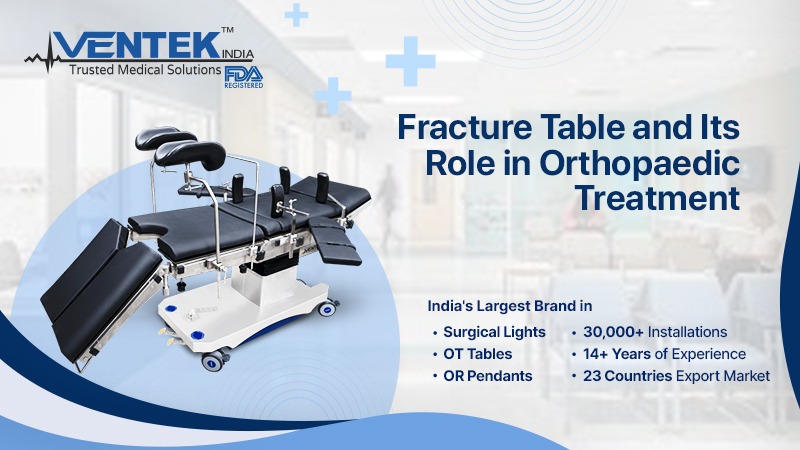
Fracture Table and Its Role in Orthopaedic Treatment
Bone surgery needs a lot of accuracy. When doctors treat a broken hip, a broken thigh bone, a pelvic injury, or any trauma case, they need to hold the patient in the right position and get clear X-ray images. A normal table cannot always do this well. This is where a fracture table helps.
A fracture table is a special surgery table made only for bone (orthopaedic) work. It pulls the limb gently, holds the broken bone in place, and lets the C-arm machine take pictures during the operation. Because more people now need bone surgery, hospitals are buying modern OT tables and fracture table systems to get better results and keep patients safe.
This blog explains what a fracture table is, how it works, where it is used, and what to check before buying one.
What is a Fracture Table?
A fracture table is a surgery table built for fractures of the hip, thigh bone (femur), pelvis, and lower legs. It lets the surgeon pull the bone, line it up correctly, and keep the patient steady from start to finish.
A normal operating table does not have these parts, but a fracture table does:
- Adjustable traction (pulling) system
- Radiolucent top (X-rays pass through it)
- Moving limb supports
- Orthopaedic attachments
- C-arm friendly design
- Fine position controls
These parts help doctors do both small and big bone surgeries with more control.
Why a Fracture Table is Important in Bone Surgery
In bone surgery, even a small movement can spoil the alignment or the implant placement. The bone must stay in the exact right spot. A fracture table solves this problem in simple ways:
| What Surgery Needs | How a Fracture Table Helps |
| Correct bone alignment | Steady traction and positioning |
| Accuracy during surgery | Holds the patient firmly |
| Clear X-ray images | Radiolucent top for C-arm |
| Less staff needed | Built-in positioning system |
| Better results | More accurate fracture setting |
Main Features of a Modern Fracture Table
- Correct limb position
The table holds the leg or arm in the right place using adjustable supports, moving arms, traction boots, and other attachments. This gives better bone setting, better implant placement, and less chance of the bone healing crooked.
- Controlled traction (pulling force)
The traction system lets the doctor pull the bone slowly and hold steady tension. This is very useful in hip fracture fixing, femoral nailing, intramedullary nailing, and pelvic surgery.
- Radiolucent top for clear imaging
The top is made of carbon fiber or HDPE, so X-rays pass through easily. This gives clear pictures during surgery and reduces the need to move the patient again and again. It is very helpful in C-arm and fluoroscopy-guided surgeries.
- C-arm friendly design
The table gives open space for the C-arm and image machines. The surgeon can take pictures from many angles without moving the patient. This makes surgery faster and lowers radiation time.
- Less manual effort
Old surgeries needed many assistants to hold the leg and keep traction. A fracture table does this on its own, so fewer staff are needed and the surgeon gets less tired.
Surgeries Done Using a Fracture Table
| Bone Surgery | Role of the Fracture Table |
| Hip fracture surgery | Correct setting and fixing |
| Femur (thigh) fracture repair | Steady traction and alignment |
| Pelvic surgery | Firm patient support |
| Intramedullary nailing | Imaging and traction help |
| Trauma surgery | Holding the fracture stable |
| Lower limb reconstruction | Exact positioning |
Benefits of a Fracture Table
- More accuracy: The steady setup lets doctors work very precisely.
- Safer for patients: Firm holding means less unwanted movement and fewer problems.
- Faster surgery: Built-in traction and positioning save time.
- Better imaging: The radiolucent top gives clear pictures without breaks.
- Simple OT setup: Fewer assistants are needed.
- Better recovery: Correct bone setting helps the patient heal faster.
What to Check Before Buying a Fracture Table
| Feature | Why it Matters |
| Radiolucent top | Needed for clear X-rays |
| Traction system | For correct bone setting |
| C-arm compatibility | For better viewing |
| Weight capacity | For patient safety |
| Electric adjustments | Easy to use |
| Orthopaedic attachments | More surgery options |
| Stability | Exact positioning |
| Easy maintenance | Long life and less trouble |
Ventek Fracture Tables for Modern Bone Surgery
At Ventek, we understand what bone surgeons and hospitals need every day. Our fracture tables are made to support hip fracture surgery, trauma cases, femur fracture fixing, pelvic surgery, and bone reconstruction.
Why choose Ventek fracture tables:
- Electric and hydraulic options
- Floor-mounted and hanging orthopaedic attachments
- Carbon-fiber radiolucent top
- C-arm friendly design
- Smooth height adjustment
- Detachable table sections
- High stability under traction load
- Easy, surgeon-friendly controls
Hospitals across India and other countries trust Ventek for strong build quality, reliable performance, easy maintenance, high safety standards, and good after-sales support. With 18+ years of experience, 1150+ distributors, and 30,000+ installations, Ventek is a name you can depend on.
Explore more Ventek products:
To ask about price or a demo, contact Ventek here or message us on WhatsApp.
Conclusion
A fracture table is a key part of modern bone surgery. It holds the limb in the right place, gives controlled traction, allows clear imaging, and makes the whole surgery smoother. From hip fractures to serious trauma cases, it helps doctors get better results and keeps patients safe.
If your hospital needs a good fracture table, orthopaedic OT table, or full operation theatre solution, Ventek offers reliable and surgeon-focused products built for today’s healthcare needs.
Learn more at ventekindia.com.