
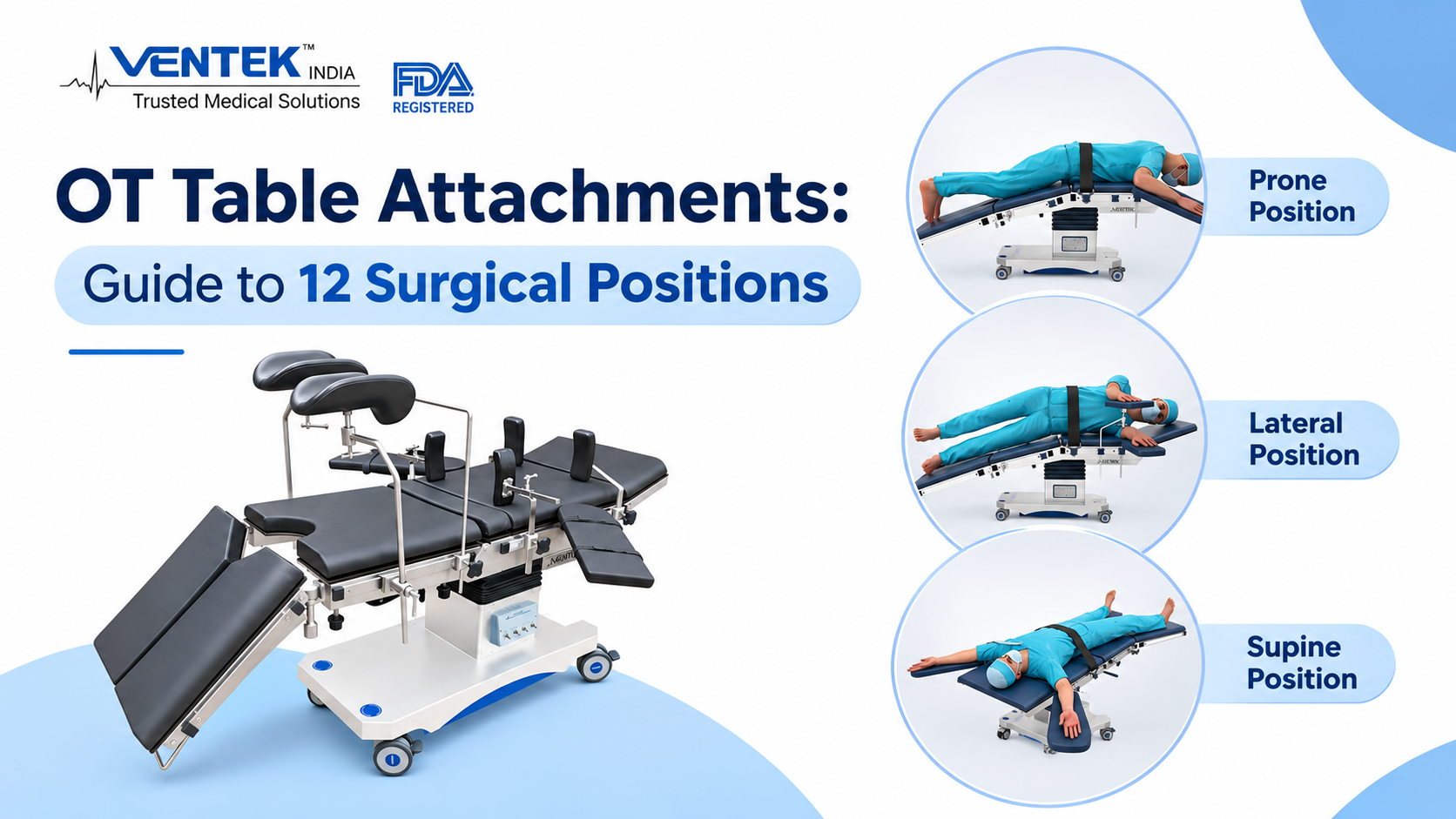
OT Table Attachments: Guide to 12 Surgical Positions
By itself, an operating table is completely flat and adjustable to heights. It’s the OT table attachments that make it a lithotomy table in the morning, a hip traction table by noon and a neuro table by evening. If the wrong set is selected, the team wastes useful time, the C arm cannot enter and needlessly pressures the nerve or skin on the patient.
We take a look at 12 common surgical positions below. You will view an animation, how the table is set up and the exact OT table accessories (with Ventek item codes) used to create this setup.
Quick Guide: Surgical Positions and Their OT Table Attachments
Short on time? Find your position here and jump straight to it.
| Position | Used for | Key attachments |
|---|---|---|
| Supine | General, laparoscopic, ENT, eye surgery | Head rest, arm rest, anaesthesia screen |
| Lithotomy | Gynae, uro-endoscopy, proctology | Lithotomy leg holders, radial clamps, short urology bed |
| Lateral kidney | Nephrectomy, flank surgery | Kidney bridge, side supports, body binder |
| Femur in lateral | Femoral nailing, endo-prosthesis | Ortho traction kit, femur in lateral support |
| DHS (hip fracture) | DHS, PFN, hip fracture fixation | Ortho traction kit, DHS extension |
| Tibia nailing | Tibial nailing under C-arm | Knee rest post, traction boot, pin holder |
| Knee (TKR) | Total knee replacement | TKR accessories, side support |
| THR (lateral) | Total hip replacement | THR accessories, pubis support |
| Beach chair | Shoulder arthroscopy | Helmet, shoulder traction pulley |
| Humerus bed | Upper arm fractures | Humerus bed, arm rest |
| Hand table | Forearm, wrist, hand surgery | Hand surgery bed, arm rest |
| Neuro | Craniotomy, cervical spine | Horseshoe head rest, 3-pin fixator |
To get the OT Table to do half the task.
Each position begins with the movements of the table itself. An electro-hydraulic table does them from a hand control and a manual one uses cranks or levers. The patient is then secured in place by attachments.
Height comes first. It helps to elevate the top for the C-arm to clear the operating room and is useful to position the work surface at an appropriate working height. Trendelenburg position is used when performing a laparoscopy of the pelvis whereas the reverse Trendelenburg position is used in laparoscopy of the upper abdomen. Lateral tilt is a movement of the top left or right and brings the working side up to the surgeon’s level.
Also, the sections are important. The rear part lifts when on the beach chair position and moves when on the leg side for kidney surgery. Lithotomy, knee flexion and ortho traction, the leg section may drop, split or come off completely. Lastly, the top slide transits the entire top lengthwise so that the C-arm can access the area that it needs to image.
Standard, Ortho Kit and Optional OT Auxiliary Desks.
Ventek separates its accessories for the operating table into three categories, with all accessories listed below classified by one of these.
Every Ventek OT table is available with all the standard accessories included. They are the Cushions, Arm rests, Side supports, Leg holders, Clamps, Screen frame and kidney bridge. The Ortho kit includes the Ventek ortho traction attachment, traction bed and telescopic arms, boots and counter-traction post and parts. All other items are Optional and are sold separately – you can choose by speciality: ortho, neuro and spine, gynae and urology, or general use.
The supine position covers general, laparoscopic, ENT and Eye Surgery.

Arms at sides/or out on arm rests, flat on back, head on head rest. It is the most frequently used surgical position and is the beginning of many other positions. Head up for gall bladder lap and head down for abdominal pelvic lap. Anaesthesia screen frame maintains the sterile field as separate.
Attachments needed (numbers match the animation)
| # | Attachment | Item code | Group |
|---|---|---|---|
| 1 | Head Rest | VTK-OTT-01 | Standard |
| 2 | Back Rest | VTK-OTT-02 | Standard |
| 3 | Center Bed | VTK-OTT-03 | Standard |
| 4 | Leg Bed | VTK-OTT-05 | Standard |
| 5 | Arm Rest with Belt | VTK-OTT-06 | Standard |
| 6 | Anaesthesia Screen Frame | VTK-OTT-08 | Standard |
| 7 | Pelvic Reconstruction Bed (for PCNL and pelvic work) | VTK-OTT-80 | Optional |
Suggestions: Air a pillow under the head, under sacrum and heels. Ensure the arms are not over 90° from the body, to avoid stretching of the brachial plexus.
Post position: Lithotomy – position for gynaec, urology and proctology examinations.
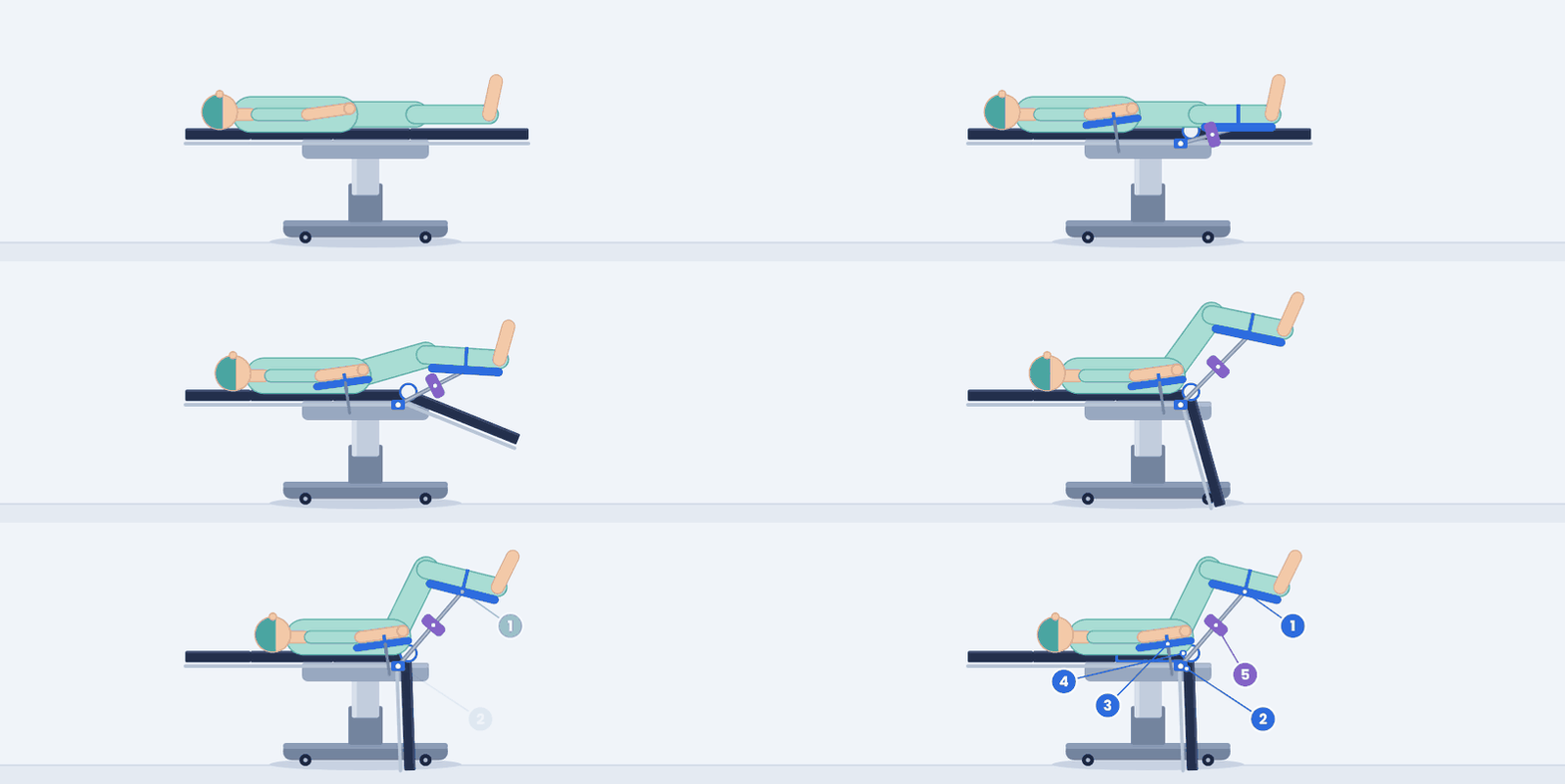
The patient slides down, ending up with buttocks at the end of the seat area, the leg area slips down and both legs are elevated into lithotomy legs that are hook and looped to the side rail. The short urology bed is made with a cut-out for liquid and instruments for uro-endoscopy.
Attachments needed (numbers match the animation)
| # | Attachment | Item code | Group |
|---|---|---|---|
| 1 | Lithotomy Leg Holder with Belt | VTK-OTT-09 | Standard |
| 2 | Radial Setting Clamp | VTK-OTT-11 | Standard |
| 3 | Arm Rest with Belt | VTK-OTT-06 | Standard |
| 4 | Short Urology Bed | VTK-OTT-04 | Standard |
| 5 | Powered Leg Stirrups – Lithotomy Leg Holders (handy for long cases) | VTK-OTT-143 | Optional |
| – | Trolley for Powered Leg Stirrups | VTK-OTT-144 | Optional |
Tip: Lift and lower both legs together, slowly. Support the calf and NOT the back of the knee, and try to remove pressure off the outside knee.
Lateral Kidney Position can be used with the Kidney Bridge.
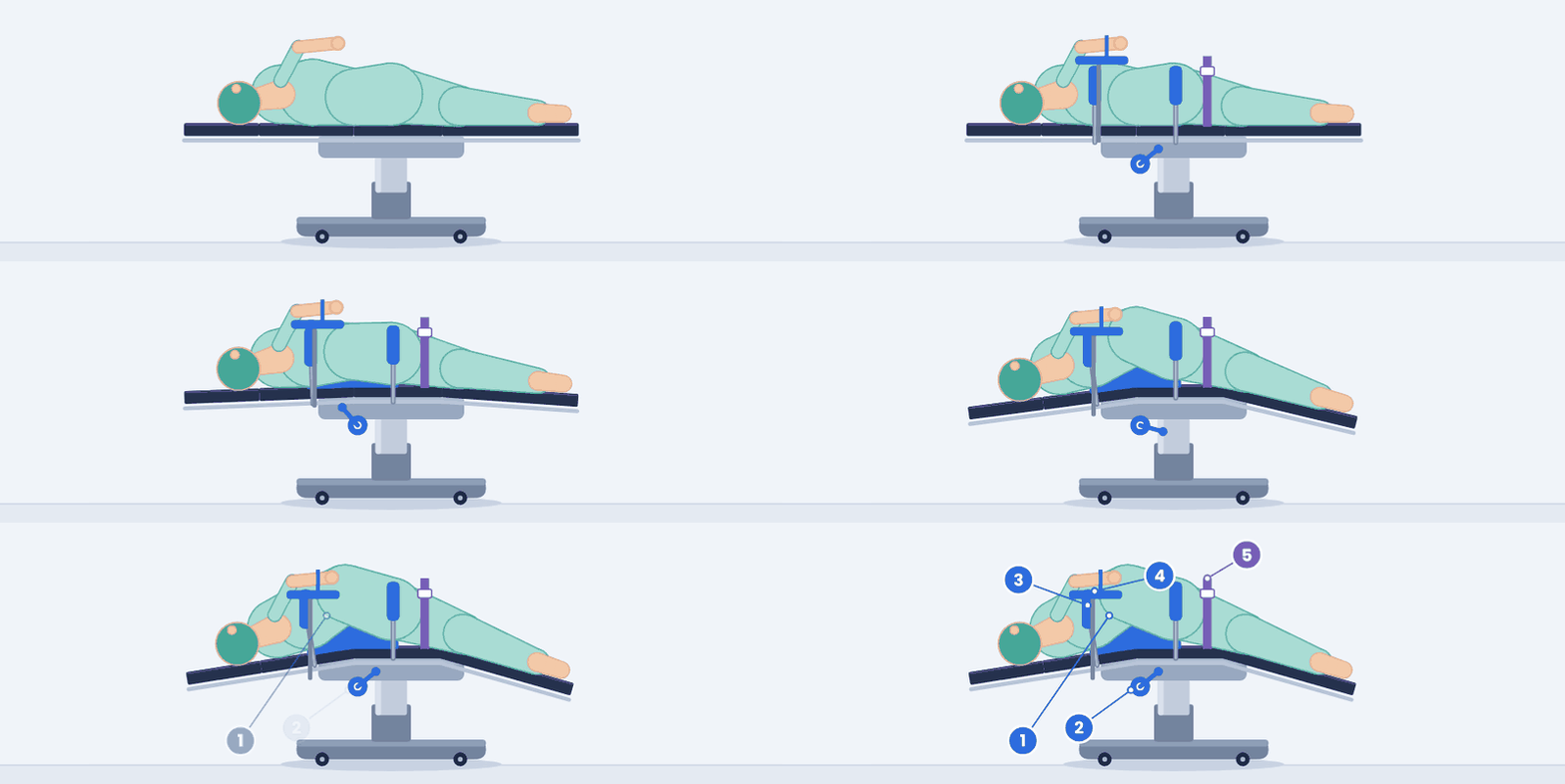
The patient is on his side, the flank on this side is over the edge of the table. Stretch the table, then screw up the kidney bridge until the space between hip and bottom is increased. Front and rear stabilisation by side supports, arm rest for upper arm and stabilisation body belt for a body provide balance.
Attachments needed (numbers match the animation)
| # | Attachment | Item code | Group |
|---|---|---|---|
| 1 | Kidney Bridge | VTK-OTT-13 | Standard |
| 2 | Handle for Kidney Bridge | VTK-OTT-14 | Standard |
| 3 | Side Support (Left + Right) | VTK-OTT-07 | Standard |
| 4 | Arm Rest with Belt | VTK-OTT-06 | Standard |
| 5 | Body Binder | VTK-OTT-173 | Optional |
Note: Himan from The KLS Guide postulates that you’ll need an axillary roll and a pillow between your knees. Then de-flatten and lower the table to its original level slowly at the end of the bridge.
Femoral Nailing, lateral on Ortho Traction Table.
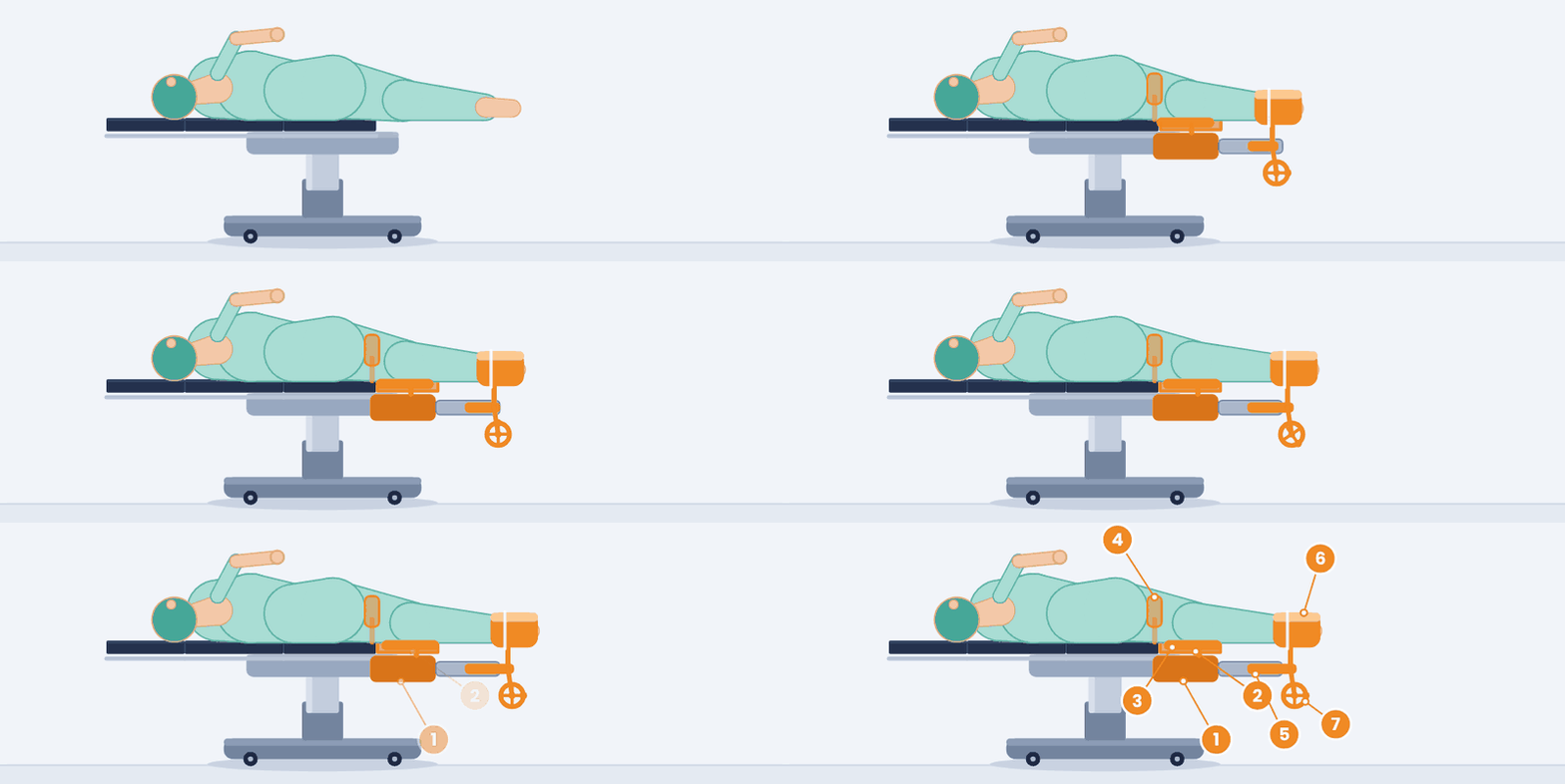
This is where an OT table can benefit from an ortho attachment. The leg is removed, the ortho traction bed is added on and the operated foot is placed in the traction boot on a telescopic arm. The pull is set by the screw tension device, the counter traction post counteracts the pull, and the femur in lateral support pulls the leg.
Attachments needed (numbers match the animation)
| # | Attachment | Item code | Group |
|---|---|---|---|
| 1 | Orthopaedic Traction Attachment | VTK-OTT-59 | Ortho kit |
| 2 | Ortho Traction Bed | VTK-OTT-50 | Ortho kit |
| 3 | Femur In Lateral | VTK-OTT-61 | Ortho kit |
| 4 | DHS/Femur Counter Traction Post | VTK-OTT-56 | Ortho kit |
| 5 | Telescopic Traction Left / Right | VTK-OTT-52 / 53 | Ortho kit |
| 6 | Traction Boot Left / Right | VTK-OTT-54 / 55 | Ortho kit |
| 7 | Screw Tension Device | VTK-OTT-51 | Ortho kit |
Tip: Pad the post, examine the foot inside the boot to be certain it is not sensitive and the circulation is excellent, and ensure there is a clear line of sight for the C-arm.
The C-Arm Compatible Orthopedic Tilt table (OT table) for both DHS and Hip Fracture Surgery.
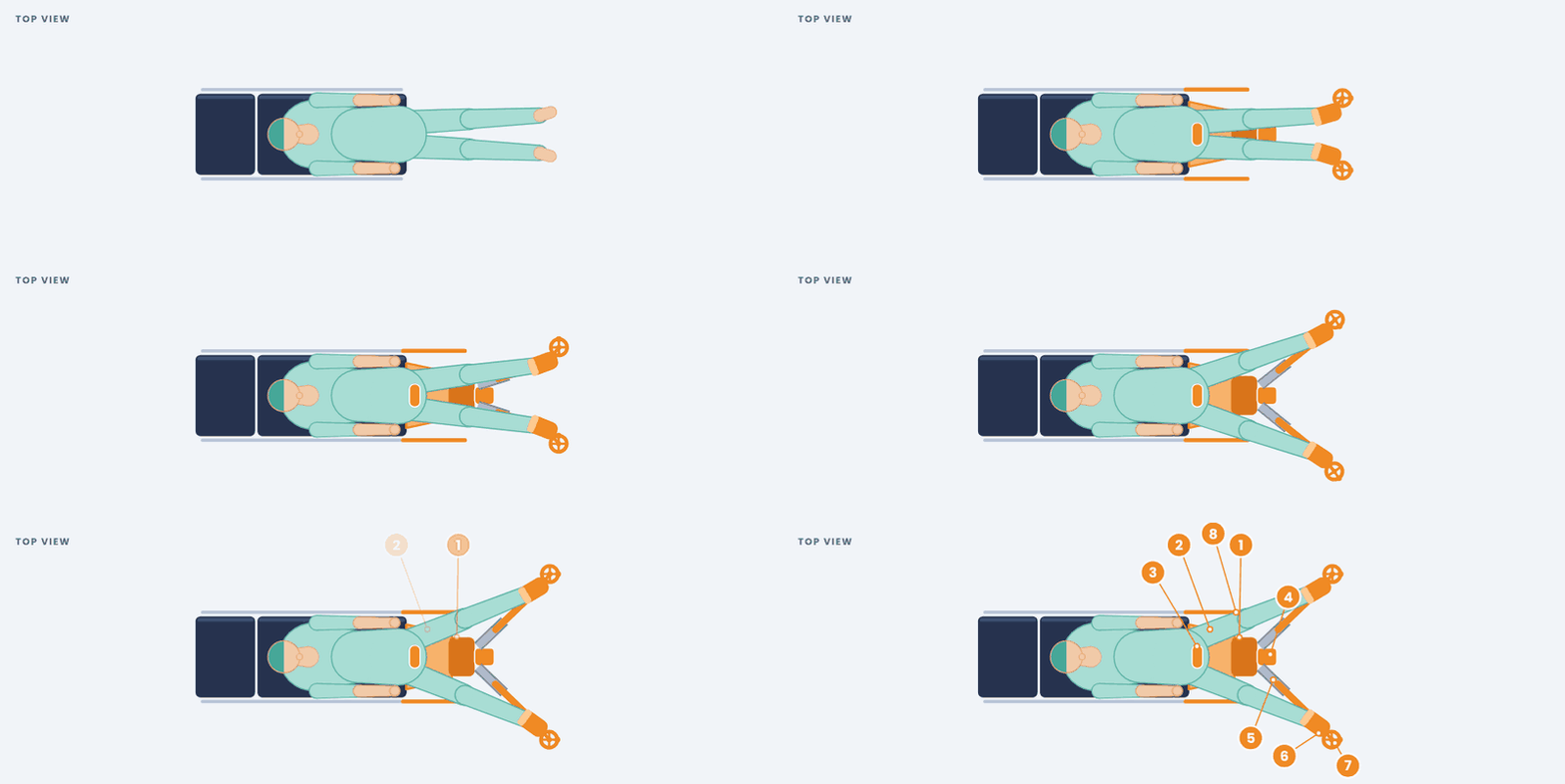
Feet go into boots both-biddies. The injured leg is drawn in to minimize the fracture, the good leg swings away to allow the C-arm to get a better view, and the DHS is extended longer to allow the screws to be used to hold the fracture. The side rail is extended over the top of table.
Attachments needed (numbers match the animation)
| # | Attachment | Item code | Group |
|---|---|---|---|
| 1 | Orthopaedic Traction Attachment | VTK-OTT-59 | Ortho kit |
| 2 | Ortho Traction Bed | VTK-OTT-50 | Ortho kit |
| 3 | DHS/Femur Counter Traction Post | VTK-OTT-56 | Ortho kit |
| 4 | DHS Extension | VTK-OTT-57 | Ortho kit |
| 5 | Telescopic Traction Left / Right | VTK-OTT-52 / 53 | Ortho kit |
| 6 | Traction Boot Left / Right | VTK-OTT-54 / 55 | Ortho kit |
| 7 | Screw Tension Device | VTK-OTT-51 | Ortho kit |
| 8 | Extension Bar | VTK-OTT-58 | Ortho kit |
Tip: Don’t over-pull. Double the perineal post and make sure to inspect for the correct rotations of the limbs before draping.
Tibia Nailing, The Hanging Tibia Position.
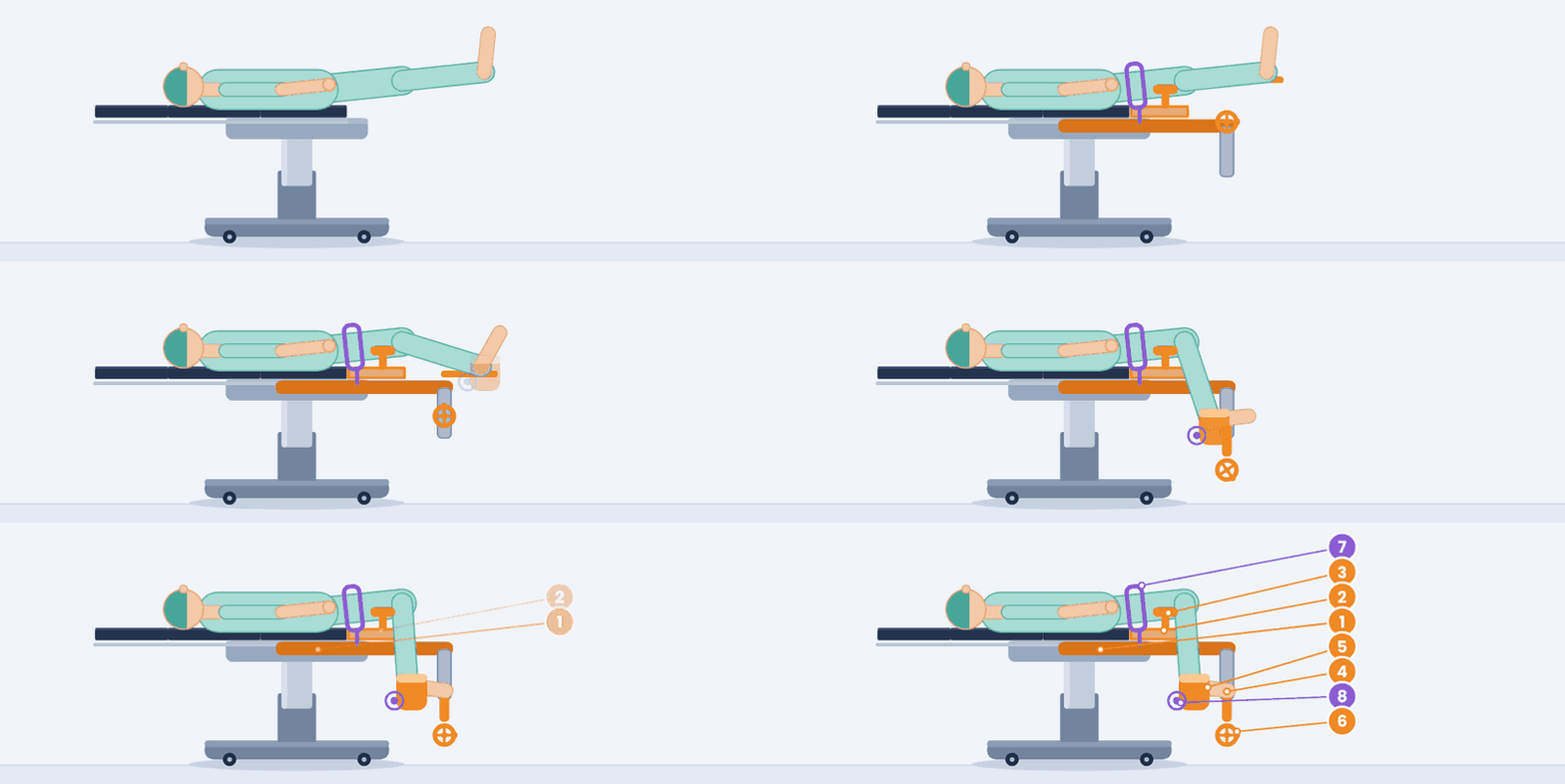
The knee is bent over a long post fixed at the end of the table, with the lower part of his leg dangling free, which is secured by a boot attached to the table, or by a Steinmann pin passed through the heel. The leg will not be on the table so the C-arm can see the leg from both sides. Side pads, developed for the tibia, provide centering between the thigh.
Attachments needed (numbers match the animation)
| # | Attachment | Item code | Group |
|---|---|---|---|
| 1 | Orthopaedic Traction Attachment | VTK-OTT-59 | Ortho kit |
| 2 | Ortho Traction Bed | VTK-OTT-50 | Ortho kit |
| 3 | Knee Rest Post for Tibia | VTK-OTT-63 | Ortho kit |
| 4 | Telescopic Traction Left / Right | VTK-OTT-52 / 53 | Ortho kit |
| 5 | Traction Boot Left / Right | VTK-OTT-54 / 55 | Ortho kit |
| 6 | Screw Tension Device | VTK-OTT-51 | Ortho kit |
| 7 | Advanced Tibia Attachment | VTK-OTT-82 | Optional |
| 8 | Steinmann Pin Holder (for pin traction instead of the boot) | VTK-OTT-91 | Optional |
Tip: Avoid exerting pressure on the back of the knee and use of pin traction, protect the pin site.
Knee Position for total knee replacement (TKR)
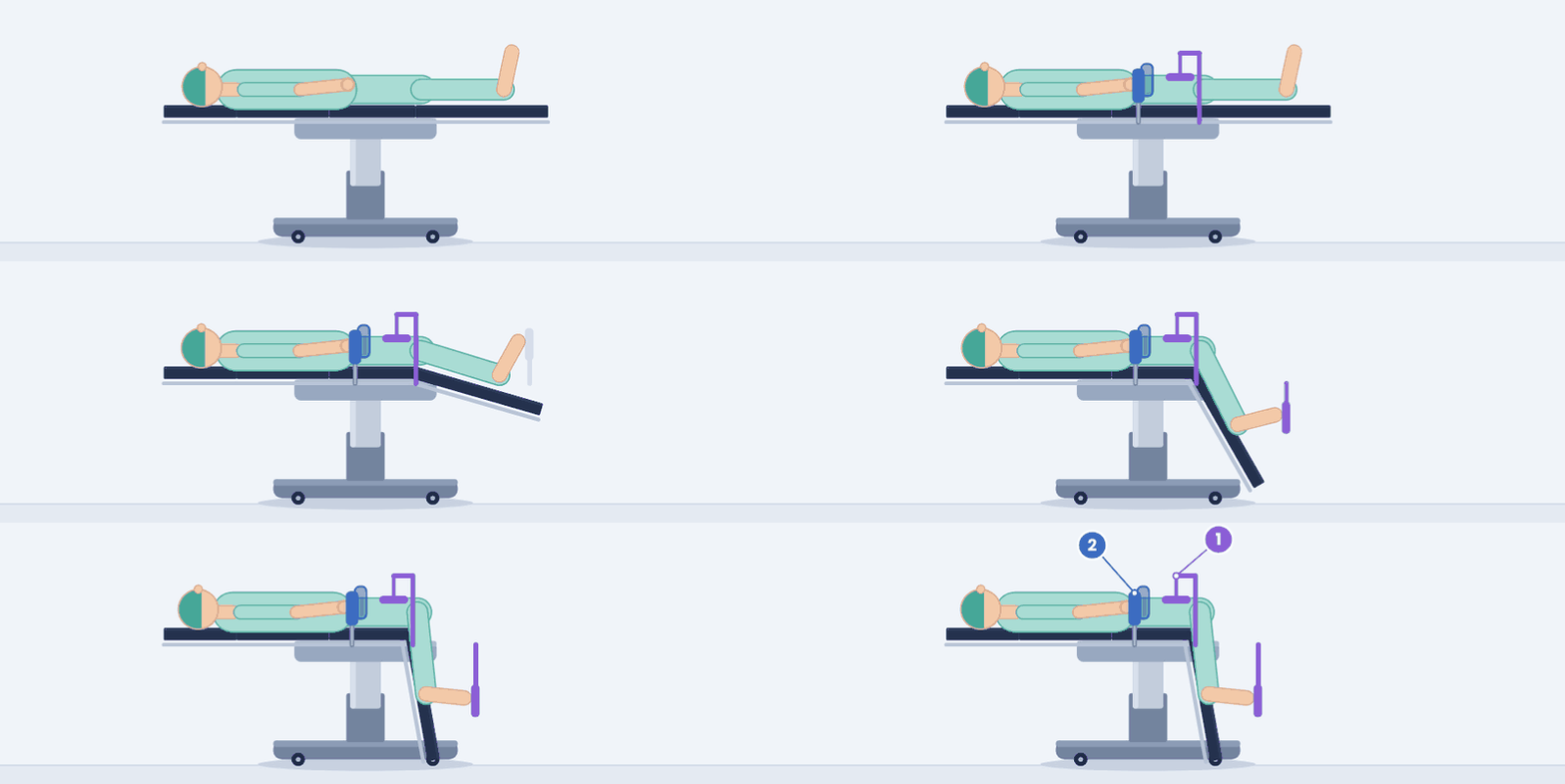
For the entire case it is critical that the knee is kept in a fixed bend in TKR. Attach the leg section, the thigh-holder and foot support from the TKR set; attach a side support to prevent the thigh from rolling out.
Attachments needed (numbers match the animation)
| # | Attachment | Item code | Group |
|---|---|---|---|
| 1 | TKR Accessories | VTK-OTT-83 | Optional |
| 2 | Side Support (Left + Right) | VTK-OTT-07 | Standard |
Remember that the holder pads do not fold, and re-verify the foot support after any various height changes.
Lateral position is used for the Total Hip Replacement (THR).
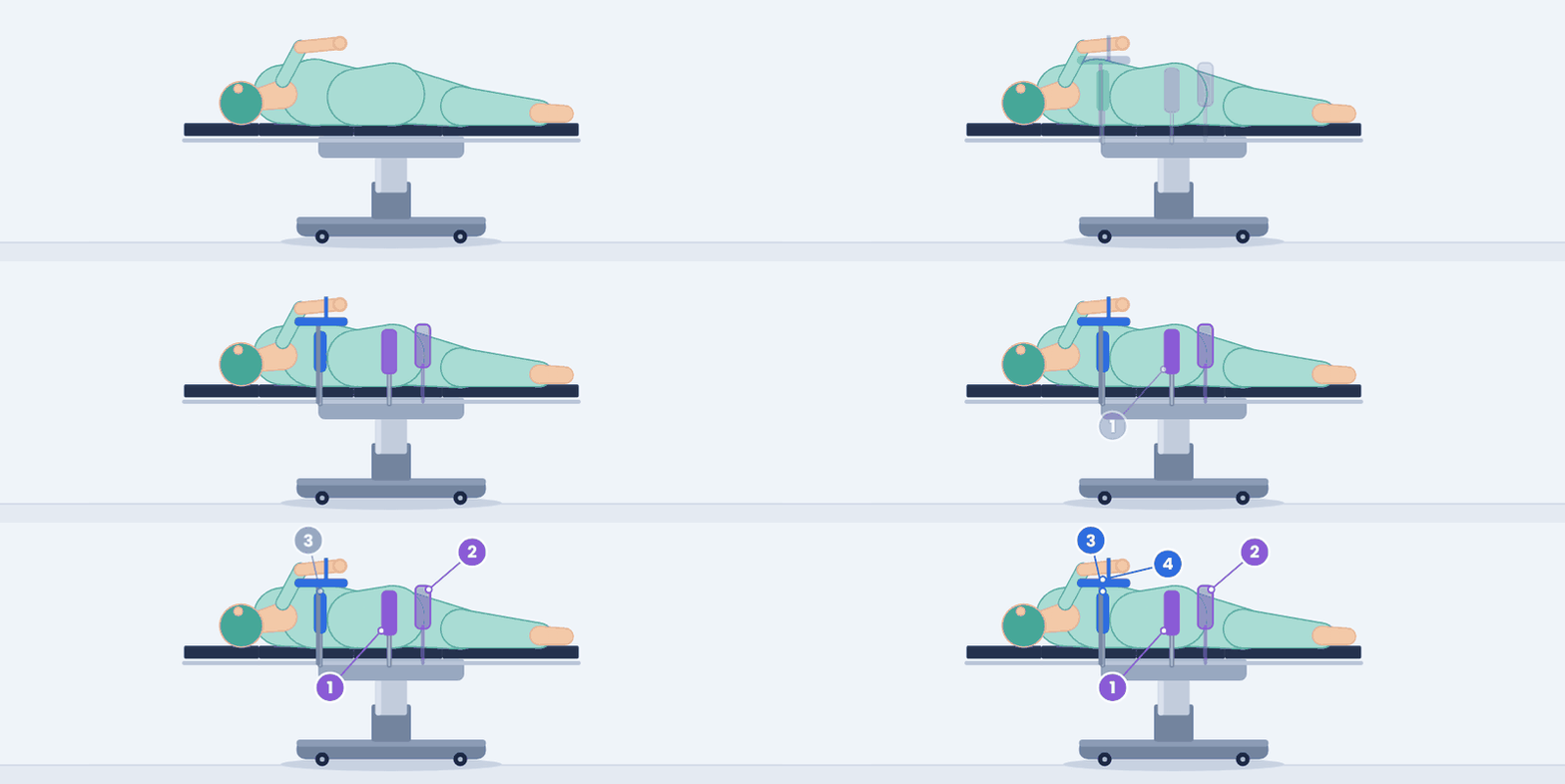
A solid pelvis is vital in hip replacement surgery, as it is used to determine the pelvis orientation angle. Patient is lying on unoperated side with supports behind sacrum and in front of pubis.
Attachments needed (numbers match the animation)
| # | Attachment | Item code | Group |
|---|---|---|---|
| 1 | THR Accessories | VTK-OTT-84 | Optional |
| 2 | Pubis Support | VTK-OTT-85 | Optional |
| 3 | Side Support (Left + Right) | VTK-OTT-07 | Standard |
| 4 | Arm Rest with Belt | VTK-OTT-06 | Standard |
To aid in draping, pad the lower shoulder and pelvis and check for squaring the pelvis.
Shoulderarthroscopy – Beach Chair Position
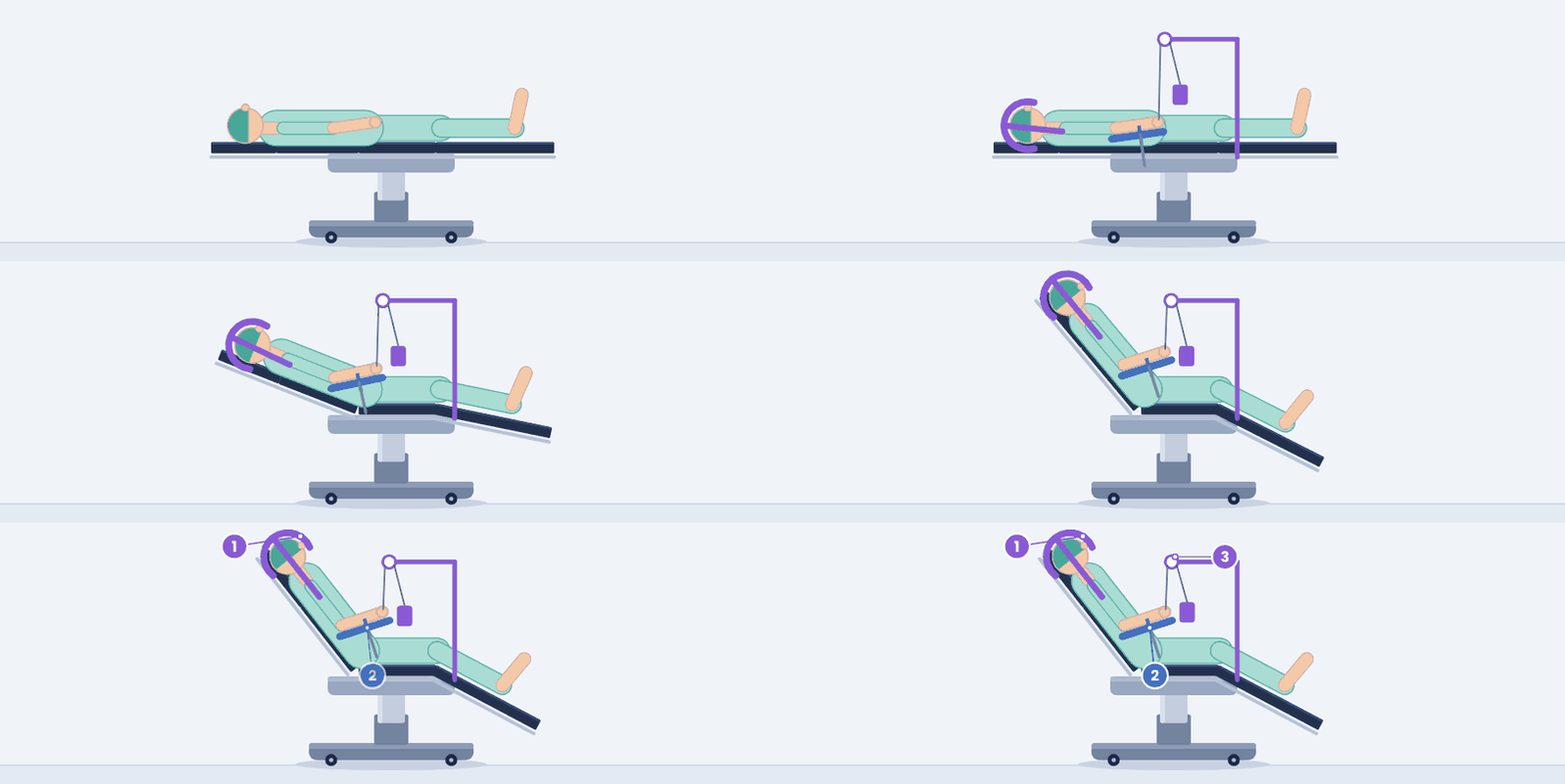
Lift the back portion to make the patient sit semi-upright, lower the patient’s legs slightly to prevent them from sliding and secure the head to the arthroscopy helmet with the neck in the neutral position. The arm, or position is on an arm rest, or in the traction pulley if the surgeon wishes to put the arm in.
Attachments needed (numbers match the animation)
| # | Attachment | Item code | Group |
|---|---|---|---|
| 1 | Shoulder Arthroscopy With Helmet | VTK-OTT-89 | Optional |
| 2 | Arm Rest with Belt | VTK-OTT-06 | Standard |
| 3 | Shoulder Traction Pulley | VTK-OTT-88 | Optional |
Note: plan blood pressure with anaesthesia (tip) when the patient is sitting.
Humerus Bed for the Upper Arm Fractures Surgery.

Patient lying on his back with his humerus (shoulder bone) rotatably placed away from the side rail at the shoulder height. The arm securely rests on it providing access for the surgeon and view for the C-arm.
Attachments needed (numbers match the animation)
| # | Attachment | Item code | Group |
|---|---|---|---|
| 1 | Humerus Bed | VTK-OTT-81 | Optional |
| 2 | Arm Rest with Belt | VTK-OTT-06 | Standard |
Be careful not to pull arm beyond patient’s tolerance and to pad the elbow.
Hand Surgery Table for Forearm and Hand Surgery.

The hand surgery bed swings out from the side rail and provides a broad and stable platform at the working height. Surgeon and assistant are on either side, with tourniquet on upper arm if required.
Attachments needed (numbers match the animation)
| # | Attachment | Item code | Group |
|---|---|---|---|
| 1 | Hand Surgery Bed | VTK-OTT-60 | Ortho kit |
| 2 | Arm Rest with Belt | VTK-OTT-06 | Standard |
Note: Remember to keep arm in a comfortable position and record the time of the tourniquet.
Neuro Attachments for cervical and Cranial Spine surgery.Neuro Attachments for Cranial and Cervical Spine surgery.

A still head and a clear head end is needed in neurosurgery. Many horseshoe head cases are being handled and when no movement is required, the 3-pin fixator securely immobilizes the skull. The neuro sitting frame is used for “semi-seated” cases, holding the fixation.
Attachments needed (numbers match the animation)
| # | Attachment | Item code | Group |
|---|---|---|---|
| 1 | Horse Shoe Shaped Cervical Attachment | VTK-OTT-110 | Optional |
| 2 | 3 Pin Fixator | VTK-OTT-112 | Optional |
| 3 | Neuro Sitting Position | VTK-OTT-111 | Optional |
Tip!: Pin placement and head angle are at the discretion of the neurosurgeon and when the patient is sitting, there are certain anaesthetic precautions that must be taken.
When purchasing an OT Table, there are a few things to consider:
If one theatre deals with all cases bar the general, ortho and gynae, then the table needs to cater for all the above positions. Above all, get moving before you purchase – these areas should be provided on the table: height, Trendelenburg, lateral tilt, back and leg sections, and top slide for C-arm access. The top of the specimen should be radiolucent, and there should be space for the C-arm at the bottom.
Next, look at the side rails. Standard rails allow OT table accessories to climb onto or off the table in just seconds. Verify that an ortho traction kit is built for that specific model and all speciality parts like neuro fixation, spine frames and powered stirrups are in the options list.
Last, but not at all least, determine the power type correctly according to the workload. Theatre environments with heavier use should utilize an electro-hydraulic table with manual override, and for lighter use, a manual hydraulic table should be used. Additionally, it will benefit to select a supplier that has a local supply of spares and cushions, along with a coded parts inventory.
Ventek manufactures OT tables, OT lights and OT pendants in New Delhi, along with the ortho, neuro and speciality attachments for them. Tell us your case mix and we’ll recommend an appropriate table and accessory package.
Help with OT Table Attachments (FAQs)
What do you mean by OT table attachments?
It’s the extra components attached to an operating table that secure the patient to the table in the specific position needed for a particular procedure or surgery, and include head rests, arm rests, leg holders, kidney bridges, traction kits and head fixators.
What acx are included on an OT table?
All Ventek OT tables are equipped with head, back, centre and leg cushions and arm rests, and side supports and anaesthesia screen frame and Lithotomy leg holders, clamps and a kidney bridge and handle. Speciality and ortho parts are not included in this plan.
An OT table is a table with an orthogonal attachment.
It is a traction set (traction bed, telescopic arms, boots, counter-traction post and tension device) which could help to make a general OT table into an orthopaedic traction table in hip, femur and tibia surgery.
Are there restriction for which operating table is suitable for orthopaedics surgery?
Not always. The table needs to be able to mount a traction attachment, have the top of the table be radiolucent, and allow the C-arm to move freely around the patient.
What does C-arm compatible OT table mean?
It has a radiolucent upper portion and a foot print of its lower portion is designed to allow the C arm to rotate around the patient while taking x-rays during surgery, with no patient movement necessary.
What are two different positions?What are two positions in differences?
The two are on the back. The supine position has straight legs; the lithotomy position has bent hips and knees and the raised legs are held in leg holders to provide access to the perineum.
A kidney bridge is used for what?
Lateral stance—a raisable under flank. Along with table flexion, it expands the space between the rib and hip to facilitate kidney surgery.
What is the procedure to order about OT table attachments at Ventek?
Please mention the item code from the list below and inform us about the surgeries you perform and party model (table) in the email sent to info@ventekindia.com We’ll let you know what will work.
Want to add an OT Table or Attachments for These Positions?
Let us know what is your table model, your surgery and position requirements. We will let you know about the correct attachments and send you a quote.
Email: info@ventekindia.com | Website: ventekindia.com
Ventek India · M-155, Sector 3, Bawana Industrial Area, New Delhi 110039
Full List of Ventek OT Table Accessories with Item Codes
Quote these codes when you enquire.
Standard: supplied with every OT table
| Item code | Accessory |
|---|---|
| VTK-OTT-01 | Head Rest |
| VTK-OTT-02 | Back Rest |
| VTK-OTT-03 | Center Bed |
| VTK-OTT-04 | Short Urology Bed |
| VTK-OTT-05 | Leg Bed |
| VTK-OTT-06 | Arm Rest with Belt |
| VTK-OTT-07 | Side Support (Left + Right) |
| VTK-OTT-08 | Anaesthesia Screen Frame |
| VTK-OTT-09 | Lithotomy Leg Holder with Belt |
| VTK-OTT-10 | Flat Clamp |
| VTK-OTT-11 | Radial Setting Clamp |
| VTK-OTT-12 | Shoulder Support (Left + Right) |
| VTK-OTT-13 | Kidney Bridge |
| VTK-OTT-14 | Handle for Kidney Bridge |
Ortho kit: supplied with the ortho traction attachment
| Item code | Accessory |
|---|---|
| VTK-OTT-50 | Ortho Traction Bed |
| VTK-OTT-51 | Screw Tension Device |
| VTK-OTT-52 | Telescopic Traction Left |
| VTK-OTT-53 | Telescopic Traction Right |
| VTK-OTT-54 | Left Traction Boot |
| VTK-OTT-55 | Right Traction Boot |
| VTK-OTT-56 | DHS/Femur Counter Traction Post |
| VTK-OTT-57 | DHS Extension |
| VTK-OTT-58 | Extension Bar |
| VTK-OTT-59 | Orthopaedic Traction Attachment |
| VTK-OTT-60 | Hand Surgery Bed |
| VTK-OTT-61 | Femur In Lateral |
| VTK-OTT-62 | Floor Support |
| VTK-OTT-63 | Knee Rest Post for Tibia |
Optional: orthopaedic
| Item code | Accessory |
|---|---|
| VTK-OTT-80 | Pelvic Reconstruction Bed |
| VTK-OTT-81 | Humerus Bed |
| VTK-OTT-82 | Advanced Tibia Attachment |
| VTK-OTT-83 | TKR Accessories |
| VTK-OTT-84 | THR Accessories |
| VTK-OTT-85 | Pubis Support |
| VTK-OTT-86 | Finger Traction |
| VTK-OTT-87 | Knee Arthroscopy Attachment |
| VTK-OTT-88 | Shoulder Traction Pulley |
| VTK-OTT-89 | Shoulder Arthroscopy With Helmet |
| VTK-OTT-90 | Hip Spica |
| VTK-OTT-91 | Steinmann Pin Holder |
Optional: neuro and spine
| Item code | Accessory |
|---|---|
| VTK-OTT-110 | Horse Shoe Shaped Cervical Attachment |
| VTK-OTT-111 | Neuro Sitting Position |
| VTK-OTT-112 | 3 Pin Fixator |
| VTK-OTT-113 | Knee Chest Position |
| VTK-OTT-114 | Radiolucent Spinal Frame |
| VTK-OTT-115 | Bow Shaped Spinal Frame |
| VTK-OTT-116 | Prone Position Bed |
Optional: general, gynae and urology
| Item code | Accessory |
|---|---|
| VTK-OTT-140 | Long Urology Bed |
| VTK-OTT-141 | Additional Bed |
| VTK-OTT-142 | Drainage Tray |
| VTK-OTT-143 | Powered Leg Stirrups – Lithotomy Leg Holders |
| VTK-OTT-144 | Trolley for Powered Leg Stirrups |
Optional: all specialities and storage
| Item code | Accessory |
|---|---|
| VTK-OTT-170 | Bolsters |
| VTK-OTT-171 | Foot Support |
| VTK-OTT-172 | IV Pole |
| VTK-OTT-173 | Body Binder |
| VTK-OTT-174 | X-ray Cassette Tray With Pushing Rod |
| VTK-OTT-175 | Gel Pads (Adult & Paediatric) |
| VTK-OTT-176 | Accessories Stand |
| VTK-OTT-177 | Orthopaedic Attachment Stand |
| VTK-OTT-178 | Manual Override Panel |
| VTK-OTT-179 | Battery Backup |
This guide describes equipment and typical set-ups to help with product selection. Patient positioning is decided by the surgeon and anaesthesia team for each case, in line with hospital protocol. Illustrations are schematic and not to scale.









Comments are currently closed.