
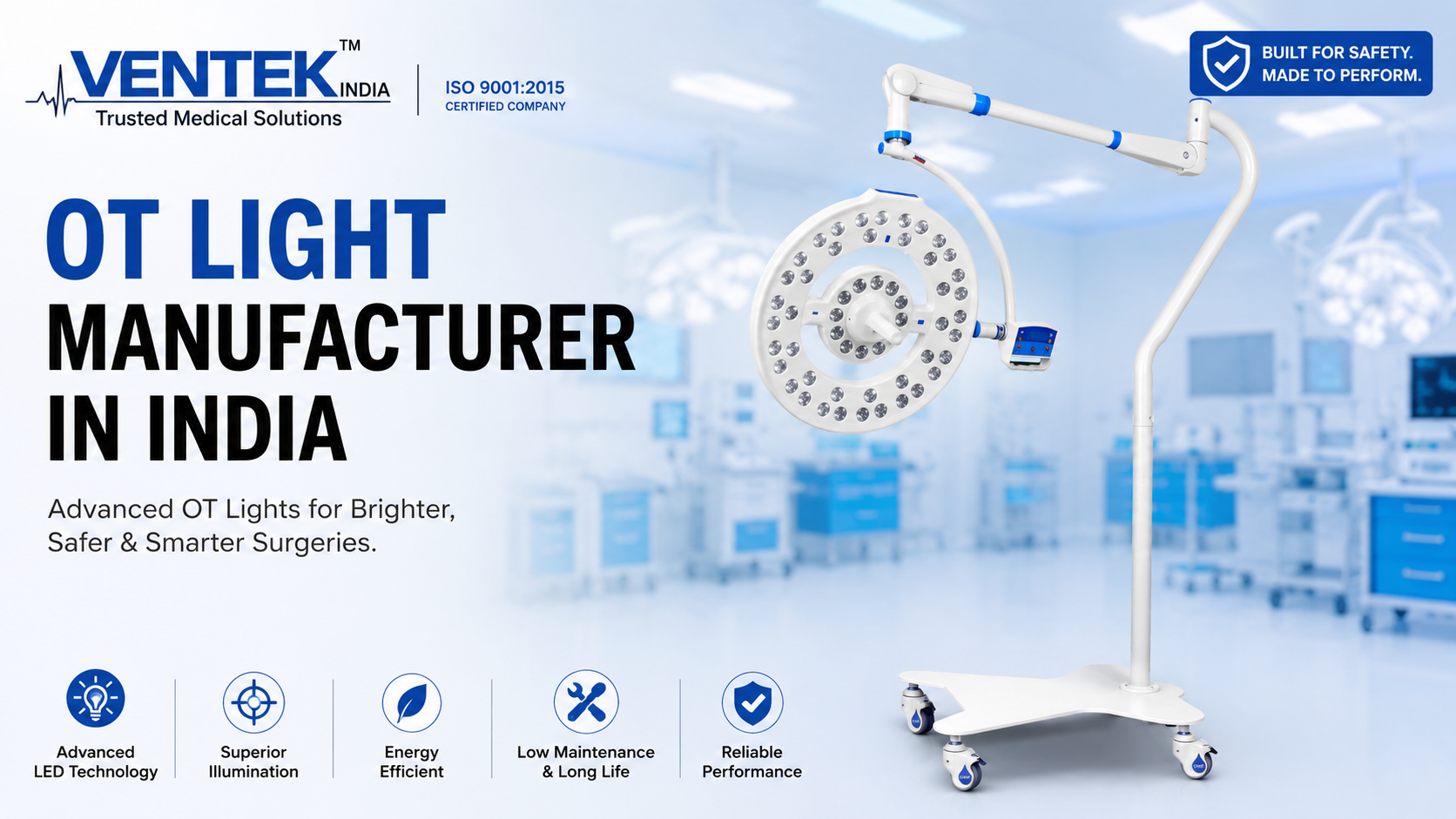
OT Light Manufacturer in India: How to Pick the Right Surgical Light — and the Right Maker
A hospital administrator in Vijayawada called us two winters ago about a light we had not sold him.
His theatre had been down for eleven days. The dome was an import, the brand had no service engineer south of Hyderabad, and the spare arm assembly was somewhere in a container. Two surgeries a day, postponed, for eleven days.
He was not asking us to fix it. He was asking how to make sure it never happened again.
That question is the real reason the choice of OT light manufacturer in India matters far more than the number at the bottom of the quotation. A surgical light is not a purchase. It is a fifteen-year relationship with whoever built it.
What does an OT light manufacturer in India actually do?
An OT light manufacturer in India designs, assembles and supplies surgical lighting systems used inside operation theatres — ceiling-mounted, wall-mounted and mobile LED lights built for shadow-free illumination, accurate colour rendering and low heat at the surgical site. A genuine manufacturer also handles CDSCO registration, on-site installation, calibration, spare parts and long-term service across the country.
Read that last line again, because that is where most procurement decisions go wrong.
The trader problem, and how to spot it
A large share of businesses advertising as operation theatre light manufacturers in this country do not manufacture anything. They import a dome, apply a sticker, and sell it as their own.
It works fine for about three years. Then a spring arm starts drooping, a driver board fails after a voltage spike, and the buyer discovers there are no engineering drawings, no spare inventory and no engineer within a day’s travel.
Four questions separate a maker from a middleman, and all four can be asked over the phone:
- Where is the manufacturing unit, and can we visit it? A real plant address is not a trade secret.
- Who holds the CDSCO manufacturing licence — you, or the company whose name is inside the dome?
- Do you stock spare arm assemblies, drivers and LED modules, and what is your typical turnaround for a replacement?
- Where is your nearest service engineer to our city? Not the nearest office. The nearest engineer.
If an answer is vague on any of these, you are talking to a trader. That is not always a dealbreaker, but you should know what you are buying before the warranty period runs out, not after.
A surgical LED is not a bright LED
This distinction gets flattened in a lot of sales conversations, so it is worth setting out plainly.
A general LED panel produces light. A surgical light has to do four jobs at once, and each one pulls against the others.
It has to hold a Colour Rendering Index high enough for a surgeon to tell healthy tissue from inflamed tissue. Below CRI 90 that differentiation starts to suffer. Ventek lights run above CRI 93.
It has to stay cool at the field, because a four-hour procedure under a hot light dries exposed tissue. LED helps here, but thermal design of the dome matters as much as the emitter choice.
It has to manage shadow from several directions at once. This is the actual clinical problem — not brightness. When a scrub nurse leans across the table, the light needs enough independent LED zones to fill in from another angle. Which is why serious major-OT configurations are double dome.
And it has to stay exactly where the surgeon parked it, hour after hour. Drift-free spring arms and high-precision brake bolts sound like a minor spec line. They are the single most common complaint we hear about competitor units.
Across the Ventek range, intensity goes up to 160,000 lux with a full 360-degree rotation, and Ventek ClearVision technology handles the optics with adjustable CCT — so colour temperature is tuned to the procedure rather than fixed at whatever the factory decided.
Six things to check on any datasheet
Before signing off on a quotation from any of the LED OT lights manufacturers on your shortlist, verify these:
- Light intensity in lux — and ask whether it is measured at one metre or at the dome face. The two numbers are very different and both get quoted.
- Colour Rendering Index — 90 is the floor for surgical work. Ask for the tested figure, not a range.
- Adjustable CCT — fixed colour temperature limits what the theatre can do across different specialities.
- Shadow management — how many independent LED zones, and how quickly the field recovers when a head or hand blocks it.
- Heat at the surgical site — ask for the temperature rise figure at the field, especially for long-procedure theatres.
- Arm stability and brake quality — this is what fails first on cheap imports, usually inside three years.
Take the six answers from each vendor and put them in a row. The gaps become obvious very quickly, and the cheapest quote is rarely still the cheapest one after year four.
Compliance and tender documentation
For any hospital procuring through a government route, paperwork is not an afterthought — it is the qualifying round.
Ventek is a CDSCO-registered and US FDA-approved manufacturer of surgical lights, with affiliations including AiMeD, FICCI, EEPC India, MSME and NSIC, plus a GeM listing for government procurement. Documentation is issued with every order for tender and audit purposes.
Ask any shortlisted vendor for the CDSCO licence number and check whose name it carries. It should match the company on your purchase order.
The Ventek range
There is no single best surgical light, and any OT light manufacturer who says otherwise is selling stock rather than solving a problem. A 15-bed maternity hospital and a 500-bed multi-speciality need very different systems.
So the catalogue is built in series:
| Series | Best suited for | Available configurations |
| Miraz / Star | Major OT, cardiac and multi-speciality theatres | Single dome, double dome, mobile, Endo Twin |
| Venus | General surgery, obstetrics, mid-size hospitals | Venus 3 to Venus 6 — single, double, mobile |
| Solitaire 48 Advanced | Teaching hospitals and recorded procedures | Single, double dome, mobile, in-light camera |
| ProLED / UltraLED / Ranger | Day-care theatres and nursing homes | Single dome, double dome, mobile |
| Laminar 54 | Theatres running laminar airflow systems | Single dome, double dome, mobile |
| Pluto 07 / Magna / Venus 1 | OPD, casualty, labour and examination rooms | Spot and examination light formats |
The complete range sits on the shadowless OT lights page — mobile, wall-mounted and ceiling-mounted, in single and double dome configurations.
How do you choose the right operation theatre light?
Choosing an operation theatre light starts with the procedures the room actually handles, not with the specification sheet. Match dome count to how much shadow control the surgery demands, mounting type to the ceiling structure, and lux and CRI to the depth and detail of the surgical field. Theatre size and airflow system settle the rest.
In practice, four factors decide it for most hospitals we work with:
- Procedure type — cardiac and deep-cavity work needs a different light to a labour room, and endoscopy needs its own optics again.
- Theatre size and ceiling height — a low false ceiling rules out certain mounting configurations before anything else is considered.
- Single dome or double dome — double dome for major OT, single dome where the field is shallow and access is straightforward.
- Airflow system — if the theatre runs laminar flow, the light body has to be aerodynamically designed for it.
Why manufacturing in India changes the outcome
Two reasons, and neither is sentimental.
Voltage. Indian hospital supply fluctuates in ways imported drivers are not designed around, particularly outside metro areas. Every Ventek unit is tested for 48 hours before dispatch — temperature cycling, extreme voltage fluctuation, and a physical QC inspection a supervisor signs off before the unit clears the floor. Building for that cannot be retrofitted later.
Service. Spares travel from Delhi, not from a port. Engineers are dispatched from a domestic network rather than routed through an importer.
The proof of both is fairly boring, and boring is the point: the oldest Ventek surgical light still in daily clinical use has crossed seventeen years of service.
Coverage across India
Eighteen-plus years of manufacturing, over 30,000 installations completed, and a network of 1,150+ distributors across 27 countries — all produced, tested and dispatched from the plant at Bawana Industrial Area, New Delhi.
| Region | Coverage |
| North India | Delhi NCR, Punjab, Haryana, Himachal, Uttarakhand, UP, Rajasthan, J&K |
| West India | Maharashtra, Gujarat, Goa, Madhya Pradesh, Chhattisgarh |
| South India | Karnataka, Tamil Nadu, Kerala, Telangana, Andhra Pradesh |
| East & North-East | West Bengal, Bihar, Jharkhand, Odisha, Assam and the North-Eastern states |
| International | 27 countries, with export documentation and packaging handled in-house |
Hospitals building or upgrading a complete theatre can source OT tables, OT pendants and the VentekSafe modular smart OT from the same plant, under the same warranty, with one point of contact instead of four vendors pointing at each other.
You can see the theatres already fitted out on the projects page.
Frequently Asked Questions
Is Ventek a manufacturer or a supplier of OT lights?
A manufacturer. The lights are produced at our own facility in Bawana Industrial Area, New Delhi, and supplied directly as well as through 1,150+ distributors. Spares, drawings and service engineers all come from the same place the light came from.
Are Ventek OT lights CDSCO approved?
Yes. Ventek is CDSCO-registered and US FDA-approved, with affiliations including AiMeD, FICCI, EEPC India, MSME, NSIC and a GeM listing. Documentation is provided with every order for tender and audit purposes.
Which OT light suits a small nursing home?
For day-care theatres and smaller nursing homes, the ProLED, UltraLED or Ranger series in single or double dome configuration usually fits well. If the theatre handles obstetrics or general surgery regularly, the Venus series is worth the step up.
Do you install and service outside Delhi?
Yes. Manufacturing happens in Delhi, but installations run across India and into 27+ countries through the distributor network, with service handled through the same channel.
How long does installation take?
A standard ceiling-mounted double dome is usually installed and calibrated within a day, provided the ceiling anchor and electrical point are ready. Pre-installation civil and electrical requirements are shared in advance so nothing stalls on site.
What is the warranty and after-sales support like?
Warranty terms are shared with the quotation and vary by series. Remote diagnostics are possible on connected models through Ventek Connect.
Talk to a manufacturer, not a middleman
If you are building a new theatre, replacing a halogen unit that has finally given out, or holding two quotations you cannot tell apart — send us the theatre dimensions, ceiling height and the procedures the room handles. We will put a configuration against them.
We do not quote off a fixed rate card, and that is deliberate. Ceiling structure, electrical load and the surgeries you actually run change the recommendation every time.
Ventek Care Pvt. Ltd. (Vandana Surgicals)
Manufacturing Unit: M-155, Sector 3, Bawana Industrial Area, New Delhi – 110039
Office: BH-14, East Shalimar Bagh, New Delhi – 110088
18+ Years of Experience | 1,150+ Distributors Globally | 30,000+ Installations



Comments are currently closed.