
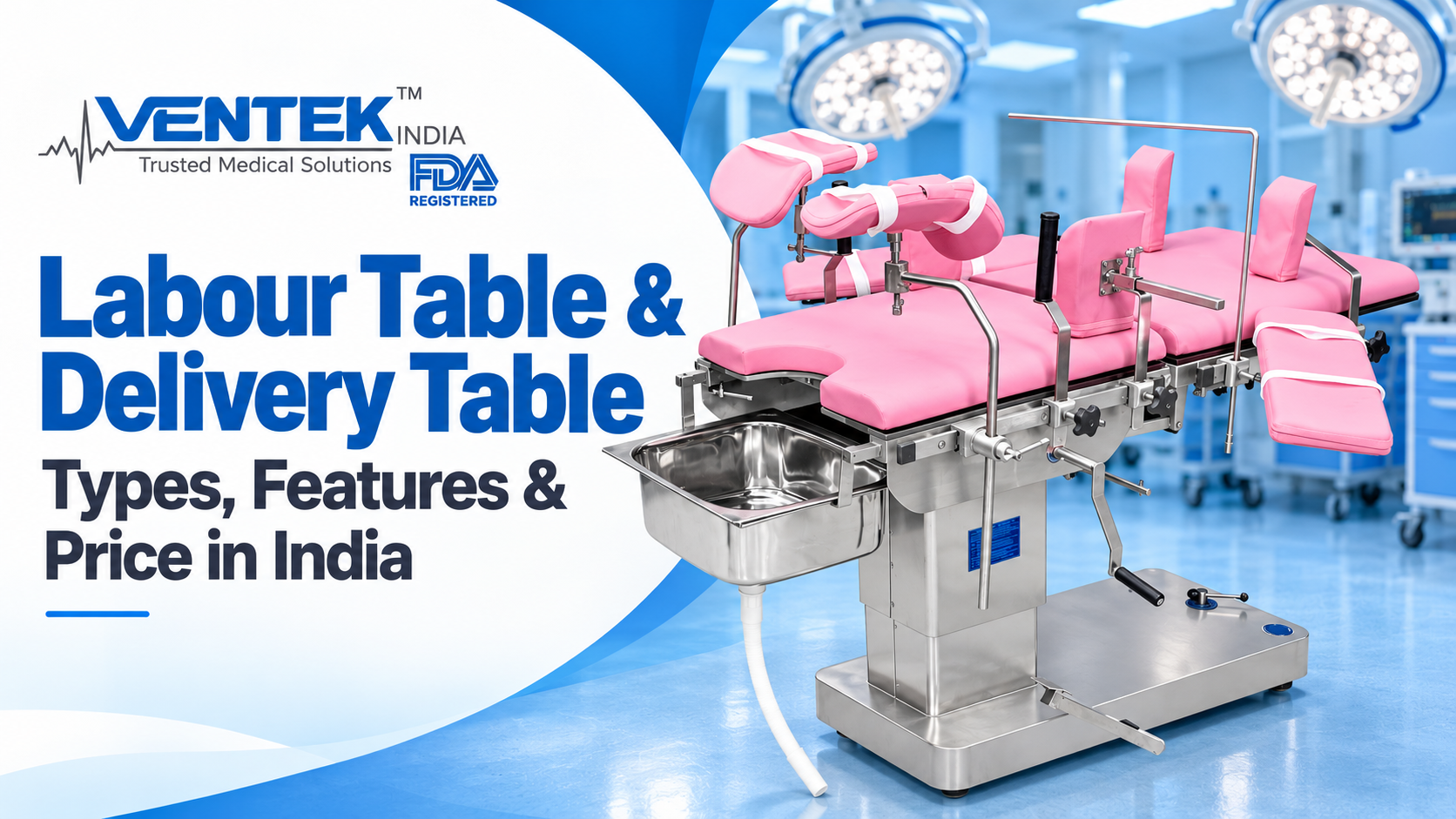
Labour Table & Delivery Table: Types, Features & Price in India
Labour tables are one of the most commonly used pieces of equipment in a hospital’s maternity ward. They have to withstand long hours of use, often during stressful shifts when doctors and nurses are short on time. A table that is hard to adjust, rocks back and forth as the mother leans into a contraction or has grooves for fluid to collect in makes the job harder for the staff while impacting the mother’s comfort, safety, and birth experience.
We know this first-hand as we supply labour tables to hospitals. This guide is written for hospital owners, gynaecologists, procurement specialists and biomedical engineers. Whether you’re building your labour room from scratch or looking to replace a table that’s hosted too many patients, here are the types of labour tables, must-have features and indicative Indian prices for 2026.
What is a Labour Table?
In its simplest form, a labour table is height adjustable furniture designed for normal delivery. That means it supports the mother throughout late labour, delivery itself and the one hour after birth. The back rises, so she can sit upright and push; the leg section lowers, folds away or retracts underneath the frame so the doctor has space to work in lithotomy position.
Just a quick point of potential confusion, which many people have asked us before buying. In India ‘labour table’, ‘delivery table’, ‘labour room table’ and ‘obstetric labour table’ all refer to the same piece of furniture. Customer searching for ‘labour table for hospitals’ and someone Googling ‘labour room delivery table’? Nine times out of ten they want the same thing.
Labour Table vs Delivery Table: Is There a Difference?
On the ward floor, hardly any. On paper, there’s a slight one, and it’s worth knowing when you’re drafting a tender or lining up quotes side by side:
| Labour Table / LDR Bed | Delivery Table | |
| Main use | The mother stays on it through labour, delivery and recovery | The mother is moved onto it only for delivery |
| Comfort | Thicker mattress, more back and leg positions | Firmer top, meant for short use |
| Leg section | Usually retracts or folds under the frame | Often detachable, or slides out |
| Common drive | Hydraulic or electric | Manual, telescopic or hydraulic |
| Typical buyer | Private hospitals, high-volume maternity units | Nursing homes, Primary Health Centres (PHCs), Community Health Centre (CHCs), district hospitals |
If your labour room handles only a couple of deliveries each day, with mothers resting elsewhere in the maternity ward, a delivery table will suffice. But if you want mothers to stay in one place, from first contraction through to recovery, an LDR-style labour table is what you need.
Types of Labour and Delivery Tables
- Manual (Fixed Height) Labour Table
It’s basic. Adjust the backrest with a gas spring or ratchet lock, and that’s it. Height doesn’t adjust. Small nursing homes like them and PHCs rely on them because they’re cheap and deliveries are few and far between. The drawback? The doctor must bend down to suit the table, rather than vice versa.
- Telescopic Labour Table
As the name suggests, you slide the foot section in and out of the main table frame. Extend it during labour so the mother can lie flat, then slide it back underneath at delivery to clear space for the doctor. Mostly manual, but way more practical than fixed height tables. You’ll find them in most Indian hospitals.
- Hydraulic Labour Table
It is controlled by a foot pump. Gas springs or levers raise and lower the back section and adjust the leg section. No need for power so electricity cuts won’t disrupt an operation. It’s why most mid-sized hospitals settle on hydraulic. It is cheap enough that you can buy them for every ward, but nicer than manual.
- Electric Labour Table (LDR Bed)
The height, backrest, leg section and tilt are controlled by a hand remote or foot switch. Staff can reposition patients in seconds, and nobody needs to lift heavy bits of metal. Batter backup is standard on most makes, as is a thicker mattress and more add-ons. Pricey? For sure. But once you’ve got a busy maternity wing they’ll pay for themselves.
- Two-Part and Three-Section Delivery Tables
It is old-school but still common. During delivery, you either pull the foot section away from the table or fold it downwards. Basic designs. Solid construction. Easy to repair. Good reason why government hospitals order more of them by far than any other type.
Features to Care About
You will find a long list of features in product brochures. Half of them won’t matter once you’ve had the table for a year. Below are the ones that will:
- Frame material – SS 304 stainless is stronger, more hygienic and corrosion resistant. Painted/mild steel tables are cheaper, but they’ll rust as soon as the paint rubs off.
- Drainage bowl / tray – Delivery tables should have a removable stainless-steel bowl fitted under the perineal area to catch fluids. It can be removed, emptied and cleaned quickly. Stay away from any tables where fluid gets into the frame.
- Foot section design – How smoothly and how quickly does the leg section retract? Watch the leg section closely as you push it down. If a delivery table jams up when you pull the foot section out flat, you’ll hear about it from the labour room.
- Leg rests and stirrups – Comfortable, height-adjustable leg rests are no longer optional. Labor can take hours. Powered leg stirrups take the strain off your staff and give you better control of the patient.
- Height range – The taller it goes, the more height variance it’ll suit. Think about the shortest and tallest doctors on staff when you’re choosing. Also makes getting onto and off the table easier for the mother.
- Trendelenburg and reverse tilt – Don’t use every day. But come in handy if you’ve got an emergency like cord prolapse or sudden blood pressure loss.
- Mattress – It should be seamless, waterproof and repel fluid penetration. No stitched joints for fluids to hold inside. Higher density foam will hold its shape longer.
- Hand grips – Attached to the bed or adjustable so the mother can hold onto something solid while pushing.
- Castors and locking – Don’t accept cheap castors with only a central brake. Individually brake each caster so the table won’t move once locked. Ideally not even 1mm.
- Load capacity – 150 kg minimum working load with a safety margin above that.
Labour Table Price in India (2026)
If you are looking for a ballpark estimate, then labour table and delivery table prices range approximately within the following limits in the Indian market (as of 2026):
| Type | Approx. Price Range | Best Suited For |
| Manual / fixed height labour table | ₹20,000 – ₹35,000 | Small nursing homes, PHCs |
| Telescopic labour table | ₹25,000 – ₹45,000 | Nursing homes, CHCs, small hospitals |
| Hydraulic labour table | ₹30,000 – ₹70,000 | Mid-size private and government hospitals |
| Electric labour table / LDR bed | ₹55,000 – ₹1,50,000+ | Busy maternity units, private hospitals |
Please note that these prices are indicative of market ranges and should not be considered an exact quotation. Variables such as build quality, material construction, accessories included and order volumes will affect the price.
Factors that affect price include:
- Type of frame (stainless steel or mild steel)
- Type of drive (manual, hydraulic or electric)
- Number of adjustable sections and tilt options
- Quality and thickness of mattress
- Accessories such as stirrups, drainage bowl, IV pole and hand grips
- Warranty and service backup available in your city
- Certifications offered (important for tendering and government sales)
Lowest price may not be the cheapest price
Let’s say you find a table that is ₹10,000 less than the rest. Now imagine it breaks down every few months or starts rusting after two years. You end up losing money. Make sure you ask about warranty terms and conditions, availability of spare parts and how quickly a service engineer can reach your hospital before you place an order.
How to Select the Right Labour Table
Start with two pieces of information. How many deliveries do you do a day? And how much can you spend? Then choose your table:
- Small nursing home (1–3 daily deliveries): Get yourself a decent telescopic table or entry-level hydraulic.
- District or government hospital: Pick hydraulic. They’ll continue working fine during power cuts. And only deal with suppliers listed on GeM.
- Private multispecialty hospital: Electric LDR beds offer the best patient experience, take effort off staff and matches expectations for private hospitals nowadays.
Always ask these questions before you order:
- Do you make labour tables, or are you a reseller?
- What grade steel do you use in the frame and tabletop?
- Are your labour tables CDSCO registered? What other certifications do you hold?
- How many years warranty do you give? What components does it include?
- Do you have a service engineer based near our hospital?
- Can we see the labour table in person before we buy? Videos / photos at the minimum.
Still choosing between suppliers? Check out our lists of top labour table manufacturers in India and delivery table manufacturers in India for some help narrowing down your list.
Setting Up Your Full Labour Room
Delivery table isn’t the only thing you need. Although it’s the most important item, a labour room also needs good lighting, and contingency plans if a normal delivery becomes a C-section.
- Lighting – OT quality shadowless lights mounted to the ceiling or on a mobile stand offer cool, bright light with zero shadows. Don’t know which size you need? Check out our post on single dome vs double vs triple OT lights.
- OT for Caesarean sections – Just in case, your obstetric OT should be fitted with a surgical table you can trust. View our range of surgical OT tables or read this guide on how to choose an OT table manufacturer in India.
- All-in-one OT setup – Setting up a new hospital? Consider a customisable solution like VentekSafe Smart OT, which includes lights, OT table and control panel in a single package.
Why Trust Ventek India with Your Labour Table
We’ve supplied operation theatre furniture and hospital equipment all over Delhi (and India) for 18 years. What does that mean for you?
- 30,000+ installations in hospitals, clinics, individual doctors and more.
- 1,150+ distributors. Supplying OT tables to hospitals in 27+ countries.
- Products CDSCO registered. OT lights USFDA approved.
- Approved OEM on GeM, so government hospitals can order directly off the portal.
- In-house manufacturing for better quality control and faster spare parts.
- Any mattress, bed size or accessories you need to customise your order.
One delivery table or furnishing dozens of labour rooms, we can help. Talk to our team to request specifications, price quotes and estimated delivery times.
Labour Table FAQs
- How much does a labour table cost in India?
Basic manual labour tables start around ₹20,000. Hydraulics range from ₹30,000 to ₹70,000+. Electric start at ₹55,000 and go up to ₹1,50,000+, depending on features.
- What’s the difference between labour and delivery table?
Labour table is short for Labour and Delivery Room table. Meaning, it’s designed to support the mother throughout labour, delivery and recovery. Delivery tables are mainly for use at the point of delivery.
In India though, they often use labour table and delivery table interchangeably when referring to the same thing.
- Which is better? Hydraulic labour table or electric labour table?
Hydraulic labour tables are more reliable, cheaper and don’t need electricity to work. Electric ones are faster, better for your staff and ideal if you have a busy maternity wing. Many hospitals specify hydraulic tables in general wards, and electric tables for their VIP labour suites.
- Define telescopic labour table?
A labour table with a foot section that slides backwards and forwards within the main table frame. Extend the foot section for labour patients. Then slide it back under the main frame at delivery, so doctors have space to operate.
- What kind of material is best for labour tables?
Stainless steel (SS 304). Stronger, lasts longer and better at dealing with disinfectants. If you’re on a budget, go for powder coated mild steel. Just know that once the paint starts to chip, the joints will rust.
- Can you purchase labour table through GeM portal by government hospital?
Yes. Government hospitals can purchase from any manufacturer enrolled on GeM. Ventek India is enrolled on GeM as an approved OEM.
- How do you clean a labour table?
Wash down and disinfect the tabletop, mattress and drainage bowl after every delivery. Monthly checks for the castors, locks and hydraulic/electric control systems. Annual service to catch anything you missed.
Labour Table Buyers Guide: The Final Word
An ergonomic labour table is the last thing you want failing you when a newborn’s ready to arrive. Choose your table type based on average daily deliveries. Never compromise on frame material or mattress quality. And buy from a manufacturer who will be in business five years from now to honour that warranty, not throw out a cheap table and vanish. For a quote, or to see the table working, contact Ventek India or send us a message on WhatsApp









Comments are currently closed.