
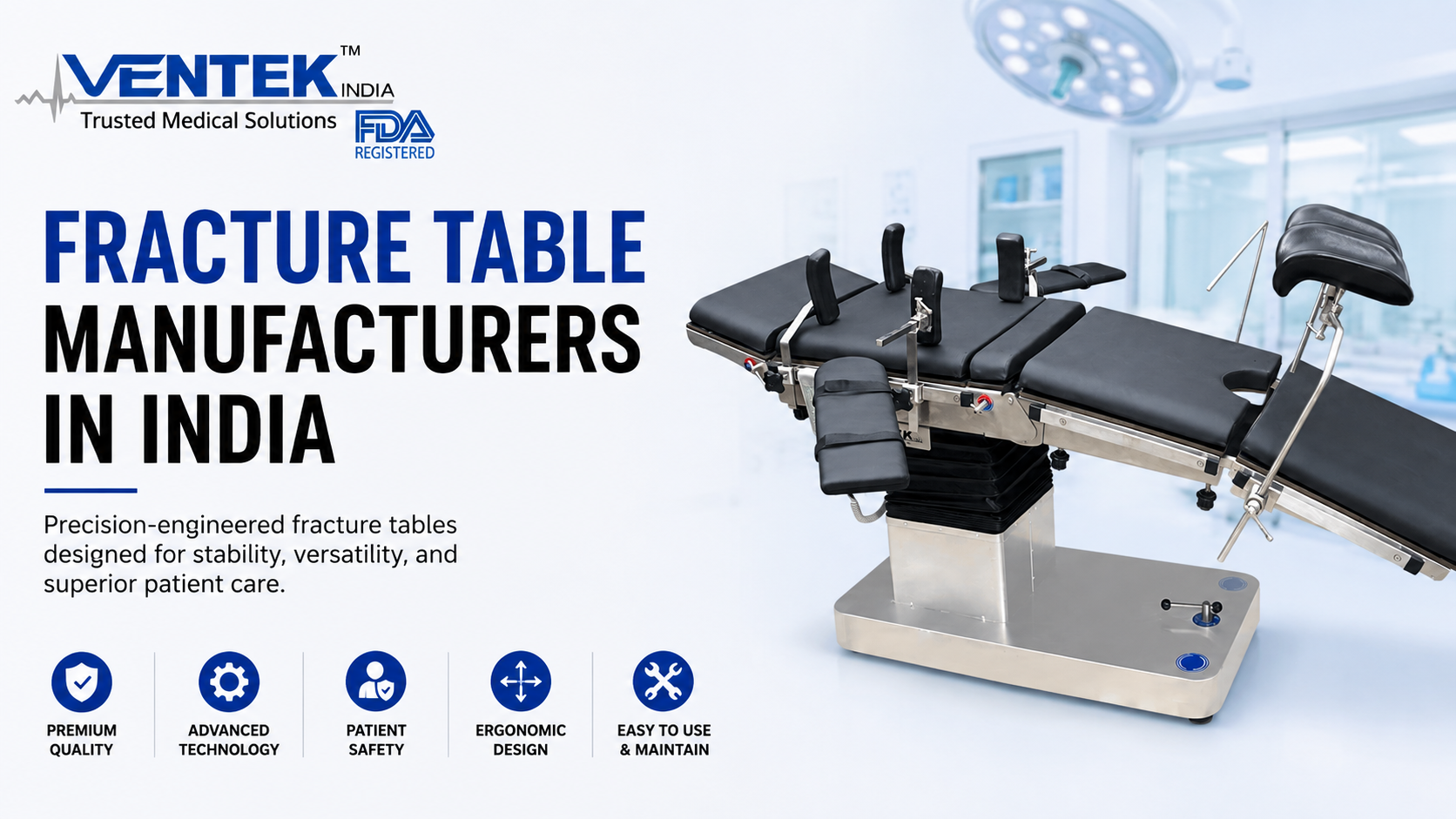
Fracture Table Manufacturers in India: What Hospitals Should Check Before Buying
An orthopaedic surgeon in Nagpur described his old setup to us like this: three assistants holding traction by hand, one C-arm technician asking everyone to move, and a hip nailing that should have taken ninety minutes stretching past two and a half hours.
Nothing was broken. The table simply was not built for the work.
That is the honest reason hospitals start looking at fracture table manufacturers in India — not because the old table failed, but because it was never designed for the surgeries the theatre is now doing.
What is a fracture table?
A fracture table is a specialised surgical table built for orthopaedic and trauma procedures. It applies controlled traction to a limb, holds the fracture in alignment through the whole procedure, and uses a radiolucent top so the C-arm can image the site without repositioning the patient. Hip, femur, pelvic and lower-limb surgeries are the main use cases.
A general OT table can support the patient. It cannot pull, hold and image the way a surgical fracture table does — and that gap is exactly where surgical time gets lost.
If you want the clinical detail on how traction and imaging work together, our earlier article on the role of a fracture table in orthopaedic treatment covers it. This page is about the buying decision.
Types of fracture tables
This is the part that confuses most procurement teams, because “fracture table” covers several very different products.
| Type | What it is | Best suited for |
| Dedicated orthopaedic fracture table | Purpose-built base with integrated traction system and orthopaedic frame | High-volume trauma and ortho centres running daily hip and femur cases |
| Modular OT table with orthopaedic attachment | General surgical table plus a detachable traction frame and limb supports | Multi-speciality hospitals where the theatre also handles general surgery |
| Electric / motorised fracture table | Powered height, tilt and traction adjustment via handset | Long procedures, teaching hospitals, and theatres wanting fine repeatable control |
| Hydraulic / manual fracture table | Foot-pump or hand-crank operation | Day-care theatres and smaller nursing homes where load is lighter |
| Carbon-fibre top systems | Fully radiolucent top with maximum imaging window | Pelvic and complex trauma work where C-arm access from many angles matters |
| Mobile vs floor-fixed base | Wheeled versus permanently anchored column | Mobile for shared theatres, fixed for dedicated ortho OT with heavy traction loads |
Most hospitals do not need the top of that list. A 60-bed hospital doing four hip cases a month is usually better served by a modular table with a good orthopaedic attachment set than by a dedicated trauma base sitting idle five days a week.
Any manufacturer who recommends the largest system before asking your case load is selling inventory, not solving a problem.
Manufacturer or trader? Four questions that settle it
A significant share of companies listed as fracture table manufacturers do not manufacture. They import a base, attach a locally sourced frame, and put a brand sticker on it.
That works until something needs replacing. Then there are no drawings, no spare traction assemblies and no engineer within reach.
Ask these four before shortlisting:
- Where is the manufacturing unit, and can we visit it? A genuine plant address is never confidential.
- Whose name is on the CDSCO manufacturing licence? It should match the company on your purchase order.
- Do you stock traction assemblies, limb supports, actuators and control handsets? Ask for typical replacement turnaround in days.
- Where is your nearest service engineer to our city? The nearest office is not the same as the nearest engineer.
Vague answers to any of these tell you what year three will look like.
Specifications worth verifying on the datasheet
Orthopaedic tables get compared on photographs far too often. These are the numbers that actually matter.
| Specification | Why it matters | What to ask for |
| Radiolucency of the top | Decides C-arm image clarity | Aluminium-equivalent filtration figure, not just “radiolucent” |
| Traction load capacity | Traction pulls against the base, not just the limb | Rated traction load and whether the base is tested under it |
| Patient weight capacity | Safety margin under articulation, not static load | Separate static and articulated figures |
| Frame material | Corrosion resistance and long-term rigidity | Grade of stainless steel used, and NABH conformity |
| Imaging clearance | How far the C-arm can travel without hitting the column | Usable X-ray window length in mm |
| Height and tilt range | Surgeon ergonomics over long cases | Minimum and maximum height, Trendelenburg and lateral tilt |
| Attachment compatibility | Whether future accessories will fit | Full attachment list and rail standard |
| Backup on power failure | Electric tables must still be positionable | Manual override or battery backup detail |
Ventek fracture and orthopaedic tables use carbon-fibre radiolucent tops with C-arm friendly design, floor-mounted and hanging orthopaedic attachments, and electric or hydraulic drive options. The Amaze series OT tables are built from medical-grade SS 304 treated for corrosion resistance as per NABH guidelines, with 13 mm plates giving C-arm X-ray filtration of ≤1 mm AL.
What actually determines fracture table price
We are asked about fracture table price constantly, and we do not publish a rate card. Here is the honest reason: the same request from two hospitals produces two different configurations.
These are the factors that move the figure:
- Dedicated system versus modular attachment — the single biggest variable, often the difference between two very different budget brackets
- Drive system — manual hydraulic, electric, or electric with battery backup
- Top material — carbon fibre costs more than HDPE, and buys you a wider imaging window
- Attachment set — traction boots, femoral supports, perineal post, arm boards, lateral supports; the set often costs a meaningful share of the table
- Weight and traction load rating — heavier-duty bases cost more to build
- Certification and documentation — CDSCO, export certification and tender paperwork
- Installation, commissioning and training — included by some vendors, invoiced by others
- Service coverage — spare availability and engineer reach are part of the real cost, even when they are not on the quotation
A cheaper quotation with a short attachment list and no service commitment is not a cheaper table. It is a table plus a future problem.
The practical approach: send the theatre dimensions, ceiling height, monthly ortho case load and the procedures you actually run. A configuration built against that will cost less than an oversized system bought off a brochure.
Compliance and tender documentation
For government and NABH-accredited hospitals, documentation is the qualifying round rather than an afterthought.
Ventek Care Pvt. Ltd. is CDSCO-registered and US FDA-approved, with affiliations including AiMeD, FICCI, EEPC India, MSME and NSIC, plus a GeM listing for government procurement. Documentation is issued with every order for tender and audit purposes.
Ask every shortlisted vendor for the CDSCO licence number, the device classification, and whether they can supply the paperwork format your tender specifies. The ones who hesitate usually cannot.
Why domestic manufacturing changes the outcome
Two practical reasons.
Power supply. Indian hospital electricity fluctuates in ways imported actuators and control boards are not designed around, particularly outside metro areas. Every unit that leaves our Bawana plant is tested for 48 hours before dispatch — temperature cycling, voltage fluctuation, and a physical QC inspection signed off by a supervisor.
Spares and service. Parts move from Delhi, not from a port. Engineers come from a domestic network rather than being routed through an importer. When a traction assembly needs replacing, the difference between three days and three weeks is the difference between rescheduling one list and rescheduling a month of them.
Coverage across India
Eighteen-plus years of manufacturing, over 30,000 installations completed, and 1,150+ distributors across 27 countries — all built, tested and dispatched from the plant at Bawana Industrial Area, New Delhi.
| Region | Coverage |
| North India | Delhi NCR, Punjab, Haryana, Himachal, Uttarakhand, UP, Rajasthan, J&K |
| West India | Maharashtra, Gujarat, Goa, Madhya Pradesh, Chhattisgarh |
| South India | Karnataka, Tamil Nadu, Kerala, Telangana, Andhra Pradesh |
| East & North-East | West Bengal, Bihar, Jharkhand, Odisha, Assam and the North-Eastern states |
| International | 27 countries, with export documentation and packaging handled in-house |
Hospitals equipping a complete orthopaedic theatre can source the OT tables, OT lights, OT pendants and the VentekSafe modular smart OT from the same plant, on one warranty, with one point of contact instead of four vendors pointing at each other.
Completed theatres are on our projects page.
Frequently Asked Questions
Is Ventek a manufacturer or a supplier of fracture tables?
A manufacturer. Tables are produced at our own facility in Bawana Industrial Area, New Delhi, and supplied directly as well as through 1,150+ distributors. Spares, drawings and engineers come from the same place the table came from.
What is the difference between a fracture table and a normal OT table?
A fracture table adds a controlled traction system, orthopaedic limb supports and a fully radiolucent top designed around C-arm access. A general OT table supports the patient but cannot maintain traction or give the same imaging window.
Which type of fracture table suits a mid-size hospital?
For hospitals running a moderate ortho case load, a modular OT table with a complete orthopaedic attachment set usually gives the best return, because the same table still serves general surgery on other days.
Are Ventek tables CDSCO approved?
Yes. Ventek is CDSCO-registered and US FDA-approved, with a GeM listing and affiliations including AiMeD, FICCI, EEPC India, MSME and NSIC. Documentation accompanies every order.
Why is the fracture table price not listed on the website?
Because configuration changes it substantially — drive system, top material, attachment set and weight rating all shift the specification. Share your case load and theatre details and we will quote against an actual configuration.
Do you install and service outside Delhi?
Yes. Manufacturing is in Delhi, but installation and service run across India and into 27+ countries through our distributor and engineer network.
Talk to a manufacturer, not a middleman
If you are equipping a new orthopaedic theatre, replacing a table that cannot keep up with your trauma load, or holding two quotations you cannot tell apart — send us the theatre dimensions and your monthly case mix. We will put a configuration against them and explain what each line does.
Ventek Care Pvt. Ltd. (Vandana Surgicals)
Manufacturing Unit: M-155, Sector 3, Bawana Industrial Area, New Delhi – 110039
Office: BH-14, East Shalimar Bagh, New Delhi – 110088
18+ Years of Experience | 1,150+ Distributors Globally | 30,000+ Installations








Comments are currently closed.