
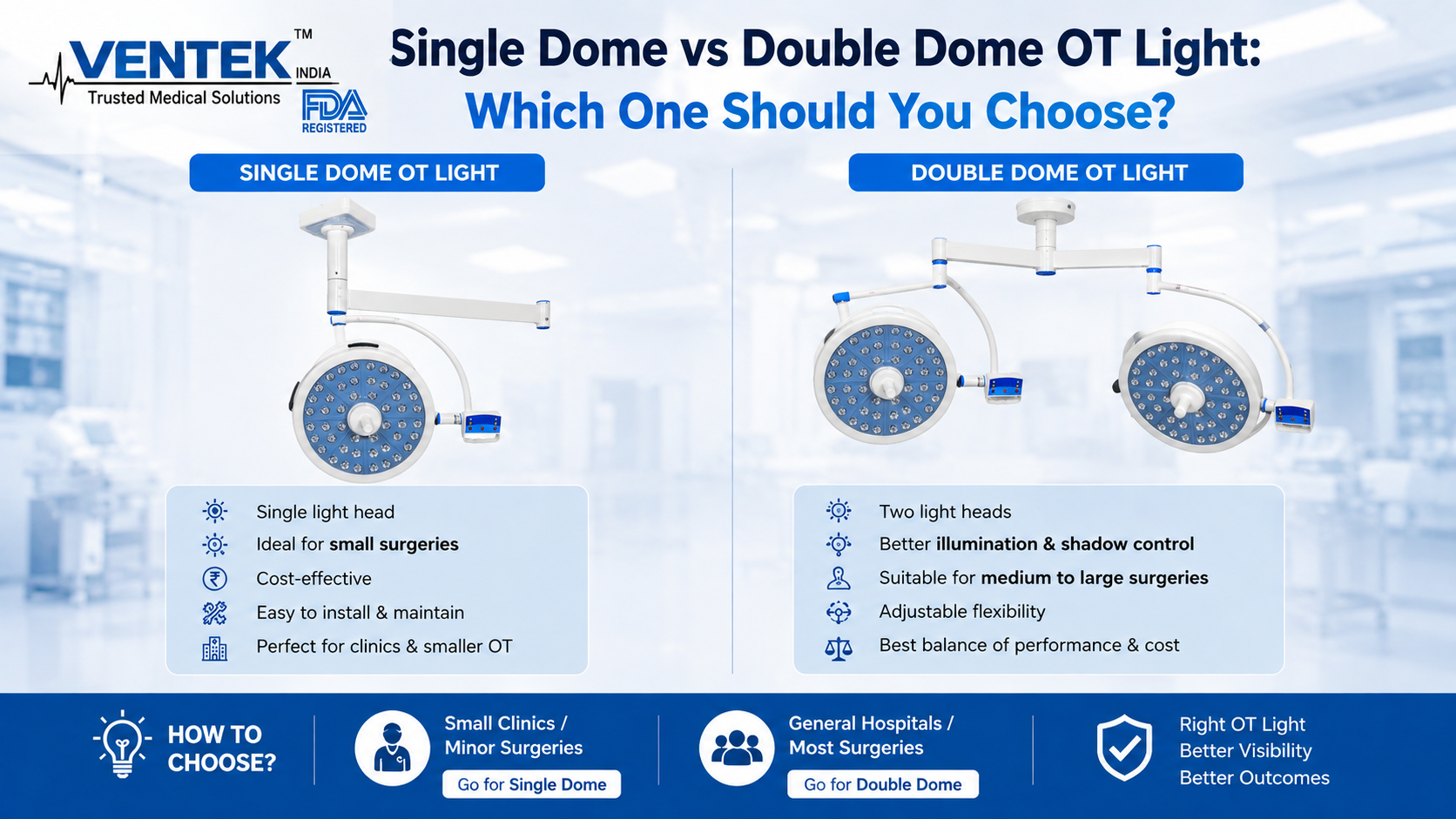
Single Dome vs Double Dome vs Triple Dome OT Light: Which One Should You Choose?
A hospital in Kharghar was setting up a brand-new operation theatre. Everything was decided — tables, pendants, flooring. Then came the OT light quote, and the whole team paused. Single dome, double dome, or triple dome? Nobody could quite say why one cost almost three times the other.
It’s a fair question. And a common one.
The number of domes on an OT light isn’t about looking impressive. It’s about how much shadow-free light the surgery actually needs. A single dome OT light has one lighting head. A double dome OT light pairs a large and a smaller head. A triple dome OT light adds a third. More domes mean more light coming from more angles — which matters a lot for deep, complex surgery and very little for a minor procedure.
Ventek India manufactures CDSCO and FDA-approved shadowless LED OT lights in single, double and triple dome configurations, installed in 30,000+ theatres across 27+ countries. So here’s a plain-language guide to picking the right one — without overpaying or underbuying.
What This Guide Covers
- What OT light domes actually do
- Single dome — uses, pros and cons
- Double dome — uses, pros and cons
- Triple dome — uses, pros and cons
- Full side-by-side comparison table
- How to choose for your theatre
- FAQs buyers keep asking
What Does a Dome Do in an OT Light?
A dome is one complete lighting head — the round or curved unit packed with LEDs that hangs over the surgical table. Each dome produces its own shadow-free beam from its own angle.
So the logic is simple. One dome lights the field from one side. Add a second dome on a separate arm, and you get a second angle that fills any shadow the first one leaves. A third dome adds even more coverage, plus a spot for an assistant or a satellite view.
More domes, more angles, fewer shadows. That’s the whole idea.
Single Dome OT Light: Simple and Affordable
A single dome OT light has one lighting head. It’s the most affordable option and the easiest to install, and for the right room it’s completely enough.
Where it fits best:
- Minor operation theatres and procedure rooms
- Small clinics, nursing homes and day-care surgery centres
- Examination rooms, casualty and dressing areas
- Dental, ENT, gynae and other short procedures
The trade-off: with only one angle of light, a hand or an instrument can still throw a shadow the light can’t fully cover. That’s fine for shallow, quick work. For deep or long surgery, it isn’t enough.
Double Dome OT Light: The Hospital Standard
A double dome OT light is the most popular choice for main operation theatres, and for good reason. It uses two heads — usually one large main dome and one smaller satellite dome — mounted on separate arms.
Because the two domes sit at different angles, when the surgeon’s hands block one beam, the second beam still lights the field. Shadows almost disappear. The smaller dome also gives an assistant or nurse their own clear view.
Where it fits best:
- General surgery, ortho, gynae and C-section theatres
- Most multi-speciality hospital main OTs
- Any theatre doing regular major surgery
For the vast majority of hospitals, a double dome is the sweet spot — strong shadow control at a sensible cost. If you can only buy one type for your main theatre, this is usually it.
Triple Dome OT Light: For Deep and Complex Surgery
A triple dome OT light adds a third head. Now three separate beams hit the site from three angles, which gives the deepest, most complete shadow-free lighting available.
This is what you want when the surgery goes deep into the body and even a small shadow is a problem.
Where it fits best:
- Cardiac, neuro and complex spine surgery
- Deep cavity procedures where light has to reach far inside
- Long, high-precision operations with a large surgical team
- Advanced tertiary-care and super-speciality hospitals
The trade-off: it’s the costliest option, needs more ceiling space, and is more than most routine theatres will ever use. Buy it because the surgery demands it — not just for the specification sheet.
Single vs Double vs Triple Dome OT Light: Full Comparison
Here’s the whole decision in one table.
| Feature | Single Dome | Double Dome | Triple Dome |
|---|---|---|---|
| Number of light heads | One | Two | Three |
| Shadow control | Basic | Strong | Best |
| Light coverage | One angle | Two angles | Three angles |
| Best for | Minor procedures, clinics | Main hospital OTs | Cardiac, neuro, deep surgery |
| Assistant view | No separate view | Yes (satellite dome) | Yes, plus extra angle |
| Ceiling space needed | Low | Medium | High |
| Cost | Lowest | Moderate | Highest |
| Typical buyer | Clinics, nursing homes | Most hospitals | Super-speciality centres |
How Do You Choose the Right Dome for Your Theatre?
Honestly, it comes down to three questions: what surgery, how deep, and how big is the team. Answer those and the choice usually makes itself.
Pick a single dome if:
- The room is for minor procedures, exams or dressings
- It’s a small clinic or nursing home with a light case load
- Budget is tight and surgeries are short and shallow
Pick a double dome if:
- It’s your main operation theatre
- You do regular major surgery — general, ortho, gynae, C-section
- You want strong shadow control without overspending
Pick a triple dome if:
- You do cardiac, neuro or deep cavity surgery
- Operations are long, complex and reach deep inside the body
- A large team crowds the field and needs multiple clear angles
Still unsure? The safest move is to match the light to the actual surgeries and theatre size, not to a generic checklist. Experienced OT Light Manufacturers in India can look at your case mix and room layout and recommend the exact dome type and lux level — instead of leaving you to guess from a brochure.
A Quick Word on Lux and CRI
Domes decide the angles. But two other numbers decide the quality: lux and CRI.
Lux is brightness at the surgical site — good OT lights sit around 1,60,000 lux. CRI (Colour Rendering Index) is how true the tissue colours look, and you want 93 Ra or higher so the surgeon can read tissue correctly. A double dome with high lux and high CRI beats a triple dome with weak numbers. So don’t count domes alone — check the full specification. Ventek’s shadowless lights carry high lux with a 93–96 Ra CRI across all dome types.
More domes help. But they’re only half the story.
Frequently Asked Questions
What is the difference between single, double and triple dome OT lights?
The difference is the number of lighting heads. A single dome has one head, a double dome has two, and a triple dome has three. More domes light the surgical site from more angles, which removes shadows better and suits deeper, more complex surgery.
Which dome OT light is best for a main hospital operation theatre?
A double dome OT light is best for most main hospital theatres. It gives strong shadow-free lighting from two angles and a separate view for the assistant, at a reasonable cost. It fits general, ortho, gynae and C-section surgery well.
Do I really need a triple dome OT light?
Only if you do deep or complex surgery like cardiac, neuro or deep cavity procedures. A triple dome gives the best shadow control from three angles but costs more and needs more ceiling space. For routine surgery, a double dome is usually enough.
Is a single dome OT light good enough for a small clinic?
Yes. For minor procedures, dressings, exams and short surgeries in a small clinic or nursing home, a single dome LED OT light is affordable and completely suitable. You only need more domes when surgery gets deep or long.
Does more domes always mean better light?
Not by itself. Domes control the angles, but lux (brightness) and CRI (colour accuracy) decide the light quality. A double dome with high lux and high CRI can outperform a poorly specced triple dome. Always check the full specification, not just dome count.
Are Ventek dome OT lights certified?
Yes. Ventek’s single, double and triple dome shadowless LED OT lights are CDSCO and FDA-approved, with 30,000+ installations across 27+ countries.
The Bottom Line
The right OT light isn’t the one with the most domes. It’s the one that matches your surgery. A single dome for minor rooms, a double dome for the main theatre, a triple dome when the operations go deep and complex. Match the light to the work, and you never over-pay or under-light.
Buy for the surgeries you actually do — not the brochure.
If you want help picking between single, double and triple dome, explore Ventek India’s shadowless OT light manufacturers in India range — CDSCO and FDA-approved, ClearVision technology, and trusted across 27+ countries. Share your theatre details and get a quote matched to your exact needs.






Comments are currently closed.