
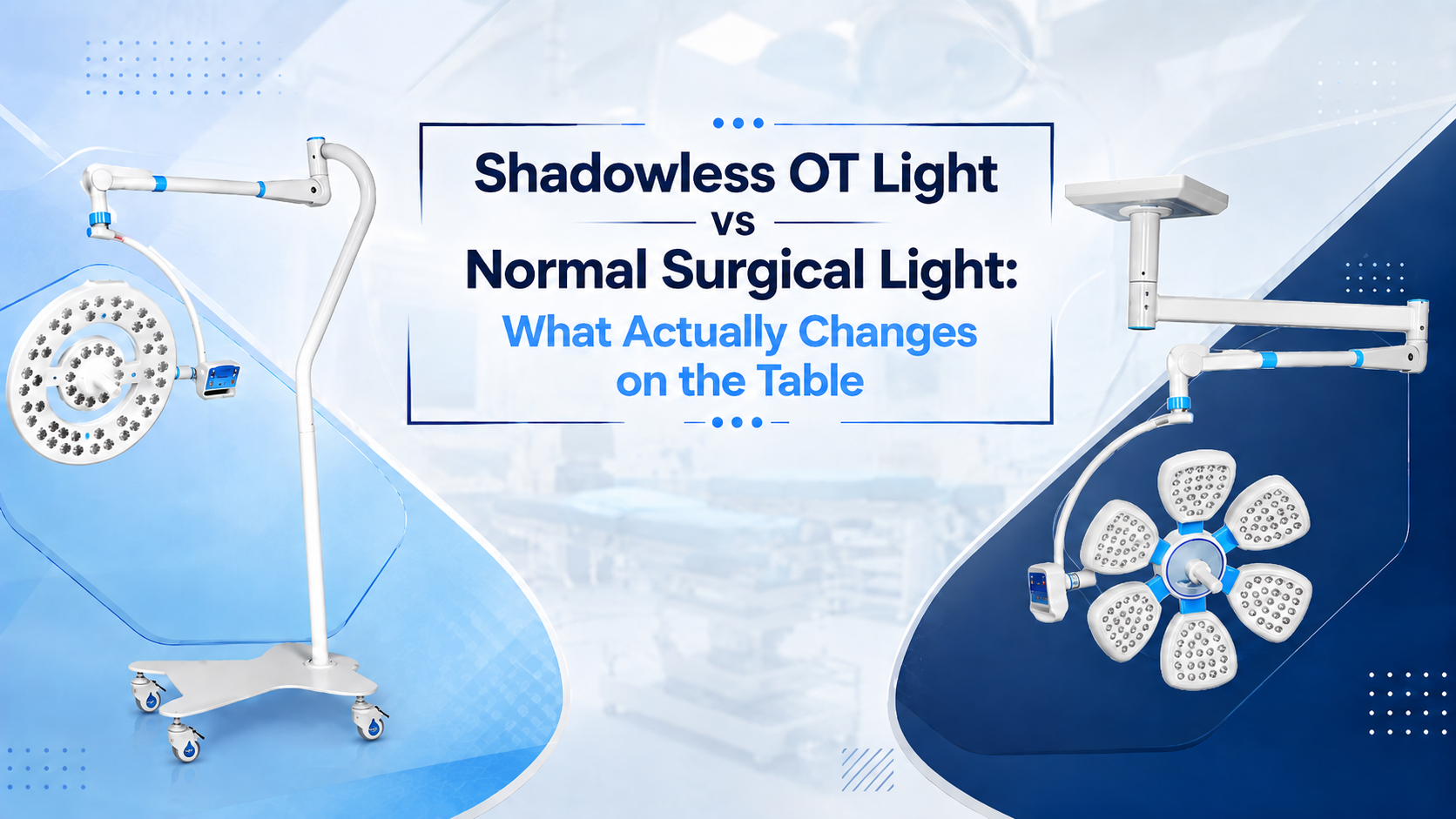
Shadowless OT Light vs Normal Surgical Light: What Actually Changes on the Table
Three hours into a bowel resection, the surgeon shifts his hands slightly to the left. A shadow falls right across the field. He stops. Someone reaches up to reposition the light. Everyone waits.
It’s a small moment. It also happens more than most people outside an operating room would guess.
And that single moment is the whole reason shadowless OT lights exist. A shadowless OT light is a surgical lighting system built to keep the operative site evenly lit even when hands, heads, and instruments get in the way. A normal surgical light — the older single-bulb or basic reflector type — simply throws bright light in one direction and hopes nothing blocks it. That difference sounds minor on paper. On the table, it isn’t.
Ventek India manufactures CDSCO and FDA-approved shadowless LED OT lights that are trusted across 27+ countries, so this comparison comes from years of watching what actually works inside real operation theatres. Let’s break it down in plain language.
What This Guide Covers
- What a shadowless OT light really means
- How a normal surgical light is different
- Side-by-side comparison table
- Which one your hospital actually needs
- Cost, life and running expenses
- FAQs surgeons and buyers keep asking
What Is a Shadowless OT Light?
A shadowless OT light is a surgical light that uses many small LED sources spread across one or more domes, angled so their beams overlap on the same spot. When a hand or instrument blocks one beam, the others fill the gap. The result is a surgical field that stays evenly lit from almost every angle.
That overlapping beam design is the trick. No single bulb, no single point of failure, no hard shadow.
Modern shadowless lights, like the ones Ventek builds with ClearVision technology, also add features a normal light was never designed for:
- Adjustable focus size — the surgeon narrows or widens the lit area to match the incision.
- High CRI (93–96 Ra) — tissue colours look natural, so it’s easier to tell healthy tissue from something that isn’t.
- Adjustable colour temperature (roughly 4200K–5000K) — the surgeon tunes the light to reduce eye fatigue.
- Low radiant heat — exposed tissue dries out slower during long cases.
- 360° rotation and drip-free arms — the dome holds its position instead of slowly sagging.
What Is a Normal Surgical Light?
A normal surgical light usually means an older halogen or single-source reflector lamp. It gives you one strong beam from one direction. For a quick dressing change or a minor procedure, that’s often enough.
But it has real limits.
Because the light comes mostly from one point, anything between the bulb and the wound casts a hard shadow. Halogen bulbs also run hot, so the surgeon feels the heat and the tissue dries faster. Colour accuracy is weaker, which matters more than people expect when you’re judging tissue by its shade. And the bulbs burn out far sooner than LEDs.
None of this makes a normal light useless. It just makes it the wrong tool for serious, long, or delicate surgery.
Shadowless OT Light vs Normal Surgical Light: Quick Comparison
Here’s the whole difference in one view.
| Feature | Shadowless OT Light | Normal Surgical Light |
|---|---|---|
| Shadow control | Excellent — overlapping beams remove shadows | Poor — hard shadows from hands/instruments |
| Light source | Multiple LEDs across the dome | Single halogen/reflector bulb |
| Heat on tissue | Low radiant heat, cool field | High heat, tissue dries faster |
| Colour accuracy (CRI) | High (93–96 Ra), natural tissue colour | Lower, colours look off |
| Focus control | Adjustable focus and intensity | Fixed beam, no real control |
| Bulb / LED life | Around 40,000+ hours | A few thousand hours |
| Running cost | Low power, few replacements | Higher power, frequent bulb changes |
| Best suited for | Major, long and delicate surgery | Minor procedures, exams, dressings |
Why Do Shadows Matter So Much in Surgery?
Shadows matter because surgery is decided in millimetres. A shadow across the operative site hides depth, hides a bleeding point, hides the exact edge the surgeon is cutting along. Even a second of guessing is a second too many when a patient is open on the table.
So the goal of a good OT light isn’t just brightness. Plenty of lights are bright. The goal is even, shadow-free brightness that stays put while people move around the field.
This is exactly where a shadowless design earns its name. Block one beam and four others cover the spot. That’s something a single-bulb normal light physically cannot do, no matter how powerful the bulb is.
Heat, Eye Strain and the Things Nobody Mentions
Ask any surgeon who has worked under an old halogen lamp for a four-hour case. The heat is real. It reaches the surgeon’s hands and forehead, and it dries the exposed tissue, which nobody wants.
LED-based shadowless lights run far cooler. Ventek’s hybrid LEDs from CREE USA are built around low radiant heat, so the field stays comfortable through long procedures. Add a high CRI and a tunable colour temperature, and eye fatigue drops noticeably — which, over a full surgical list, actually matters for concentration.
Small thing. Big difference by hour three.
Which One Does Your Hospital Actually Need?
Honestly, it depends on where the light will be used. Here’s a simple way to decide.
Choose a shadowless OT light when:
- You run a main operation theatre with major or long surgeries
- You do delicate work — surgery involving fine tissue, deep cavities or precise margins
- Colour accuracy and a cool, shadow-free field are non-negotiable
- You want low running cost and long LED life over the years
A normal surgical light may be fine when:
- It’s for a small procedure room, dressing area or examination bay
- Procedures are short and minor
- Budget is very tight and the case load is low
For most hospitals, nursing homes and surgical centres, the main OT should have a proper shadowless light. It’s a patient-safety decision as much as an equipment one. If you’re comparing models and certifications, it’s worth talking to established OT Light Manufacturers in India who can match the dome type and lux level to your theatre size.
What About Cost and Long-Term Value?
A normal surgical light usually costs less upfront. That’s the honest part of its appeal. But the maths changes once you look at the full life of the equipment.
Halogen bulbs are cheap individually, yet they burn out every few thousand hours and pull more power. Over five years, those replacements and that electricity add up. A shadowless LED light costs more at purchase but runs for around 40,000 hours, sips power, and rarely needs a bulb swap.
So the cheaper light is often the more expensive one — you just pay for it slowly.
| Cost Factor | Shadowless LED OT Light | Normal Surgical Light |
|---|---|---|
| Upfront price | Higher | Lower |
| Replacement frequency | Rare (long LED life) | Frequent bulb changes |
| Power consumption | Low | Higher |
| 5-year total cost | Lower overall | Often higher overall |
Don’t Skip the Certifications
One thing buyers rush past: approvals. A surgical light sits directly over open patients, so it has to meet safety and quality standards. In India, look for CDSCO registration. For exports and higher trust, FDA and CE certification matter too.
Ventek’s shadowless OT lights are CDSCO and FDA-approved, backed by 18+ years of manufacturing, 1150+ distributors globally and 30,000+ installations. Those numbers aren’t marketing decoration — they’re the track record that tells a procurement team the equipment has actually held up in real theatres.
Frequently Asked Questions
Is a shadowless OT light better than a normal surgical light?
For most surgeries, yes. A shadowless OT light removes hard shadows, gives accurate tissue colour, and runs cool, which a normal single-bulb light cannot match. A normal light is only suitable for minor procedures, dressings or examinations.
How does a shadowless OT light remove shadows?
It uses many small LED beams from across the dome, all aimed at the same spot. When a hand or instrument blocks one beam, the surrounding beams still light the area, so no dark shadow forms on the surgical field.
What CRI should an OT light have?
Look for a CRI of 93 Ra or higher. A high CRI means tissue colours look natural and true, which helps the surgeon tell healthy tissue from problem areas. Ventek lights deliver CRI in the 93–96 Ra range.
Do LED shadowless lights really save money?
Over time, yes. They cost more upfront but last around 40,000 hours, use less power, and rarely need replacement. A normal halogen light is cheaper to buy but costs more in bulbs and electricity over the years.
Which OT light is best for a small hospital or nursing home?
A single-dome or mobile LED shadowless light is usually ideal. It gives shadow-free, high-CRI light for a smaller theatre without the cost of a large twin-dome ceiling system. A manufacturer can help match the model to your room size.
Are Ventek OT lights certified?
Yes. Ventek’s shadowless LED OT lights are CDSCO and FDA-approved and are used across 27+ countries, with 30,000+ installations to date.
The Bottom Line
A normal surgical light gives you brightness. A shadowless OT light gives you brightness you can trust — even, cool, colour-accurate, and stable while a whole surgical team moves around the field. For any theatre where the surgery is serious, that’s not a luxury. It’s the baseline.
So when you plan or upgrade an operation theatre, put the shadowless light in the main OT and keep the simpler lights for minor rooms.
If you’re ready to compare domes, lux levels and certifications for your own theatre, explore Ventek India’s shadowless OT light manufacturers in India range — CDSCO and FDA-approved, ClearVision technology, and trusted across 27+ countries. Get a quote and pick the right light before the next case, not after.







Comments are currently closed.